
Episode #217: On Sacred Space and Scrap Metal with Jerome China
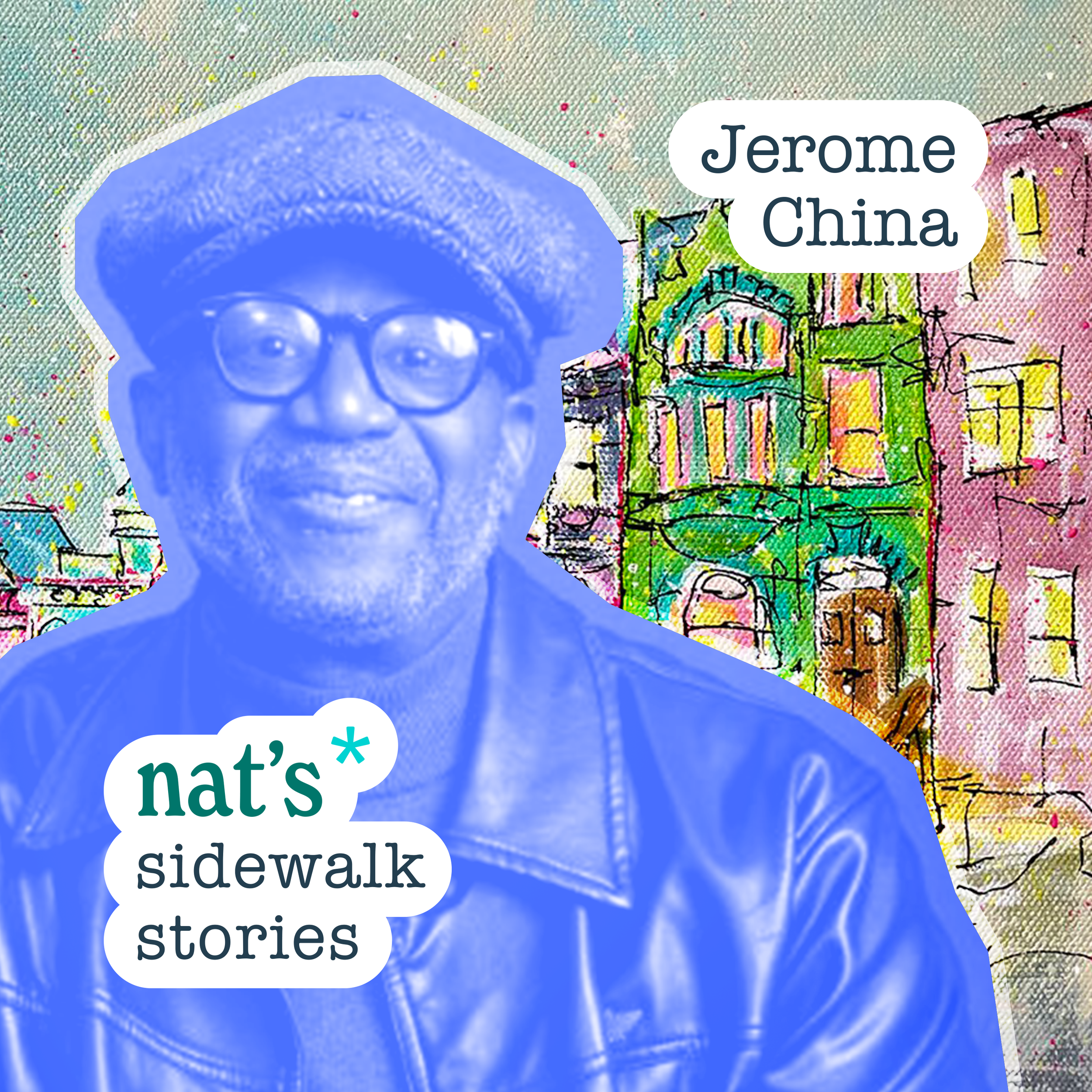
About This Episode
Happy holidays everyone! Today I'm really thrilled to share a conversation with Jerome China, a metal sculptor who transforms his McGinley Square backyard into a sanctuary - both a creative space and what he calls "the only place on earth where I don't have to compromise." Jerome's journey from needing a fence to becoming an artist, his Buddhist practice, and his connection to Jersey City make this a conversation about freedom, persistence, and the power of sacred spaces. This is a perfect episode to close out the year, a meditation on place, purpose, and artistic practice.
Meet Jerome China
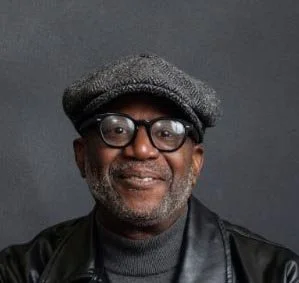
Jerome China is a metal sculptor based in Jersey City's McGinley Square area, near Lincoln Park. His artistic journey began in 2012-2013 when a simple fence commission led him to discover the transformative power of working with scrap metal. After convincing the fabricators at All Iron Works on Cole Street to teach him their craft, Jerome spent six Saturday sessions creating his first backyard sculpture. Today, his work honors the history of the industrial revolution while giving reclaimed materials their second life. A Buddhist who came to the art profession later in life, Jerome believes deeply in art's power to save lives — a conviction born from his own experience with afterschool art programs in Richmond, Virginia that kept him out of harm's way. In 2022, he produced the exhibition "Blackity Black" at Novado Gallery, showcasing 10 African American abstract artists in a show that made Tris McCall's top 10 list of art exhibitions for the year.
Connect with Jerome China
Instagram: @chinajerome
Upcoming: Solo exhibition opening February 19, 2025 at Hudson Guild Gallery in Chelsea, New York (runs through April 15, 2025)
Key Insights
Jerome's backyard studio is "the only place on earth where I don't have to compromise"—a sacred space that represents total creative freedom, especially powerful as a Black man in America
His journey to becoming an artist began with needing a fence: commissioning All Iron Works on Cole Street led to discovering they made artwork from scrap metal, and after persistent asking, they gave him six Saturday sessions to create his first sculpture
Jerome practices Buddhist meditation for 15 minutes before entering his studio to clear his mind, part of a household practice of chanting mornings and afternoons
Afterschool art programs in Richmond, Virginia literally saved Jerome's life—while many childhood friends didn't make it out, those programs gave him a safe place and kept him from potentially compromising environments
Once a piece enters a collector's hands, Jerome has no attachment to it—they can rename it, move it to a wall instead of a pedestal, or transform it as they wish: "I've done what I needed to do at that particular time"
Jerome lived in Jersey City from 1986-1990 with no connection to the city, spending all his time in New York, then returned in 2001 and developed deep roots in McGinley Square
He periodically opens his sculpture garden to neighbors, promoting through newsletter and social media, encouraging others to share since his network alone only reaches the same people
Visual Documentation
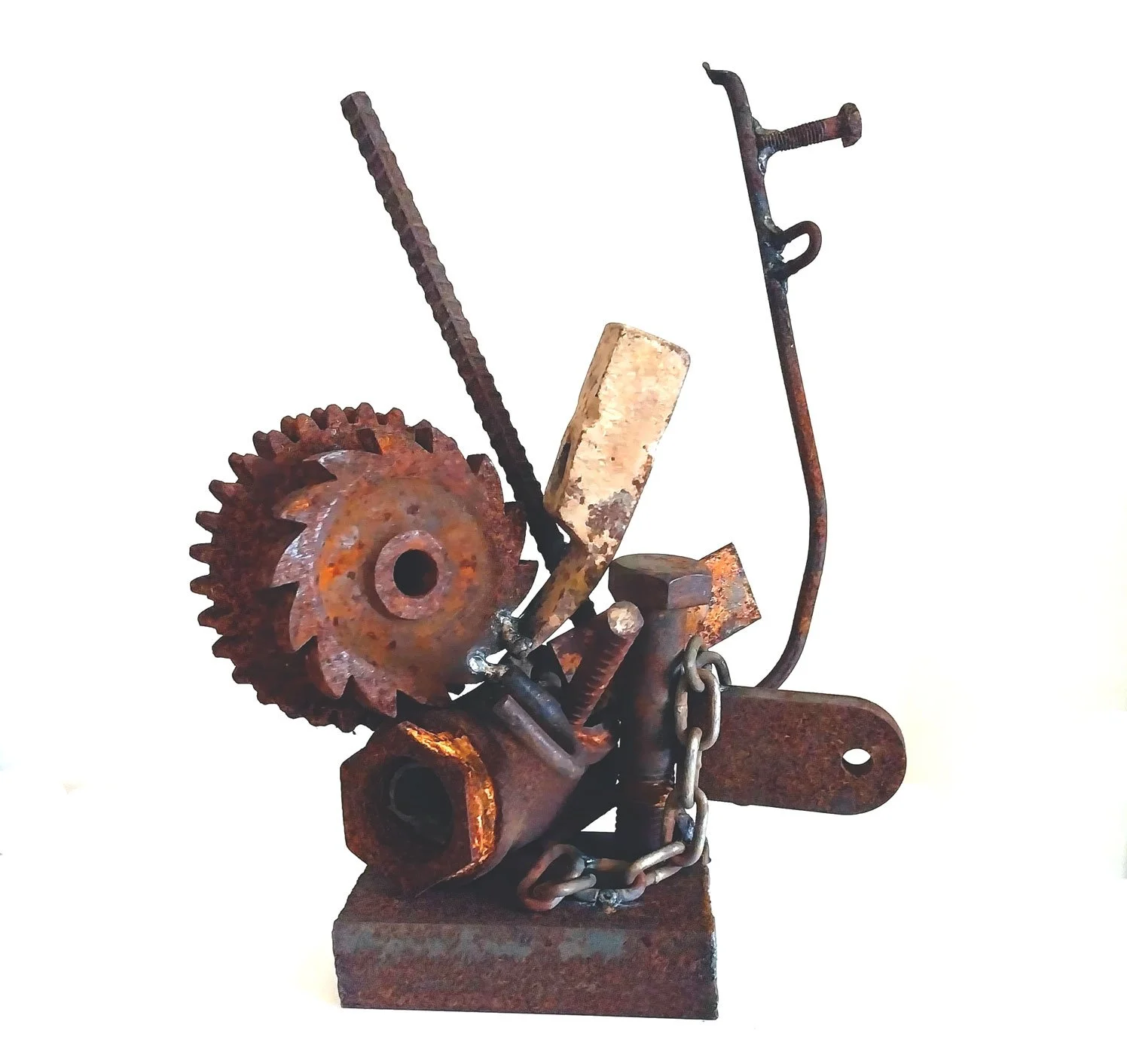
Scraps from the Table by Jerome China - photo courtesy Jerome China
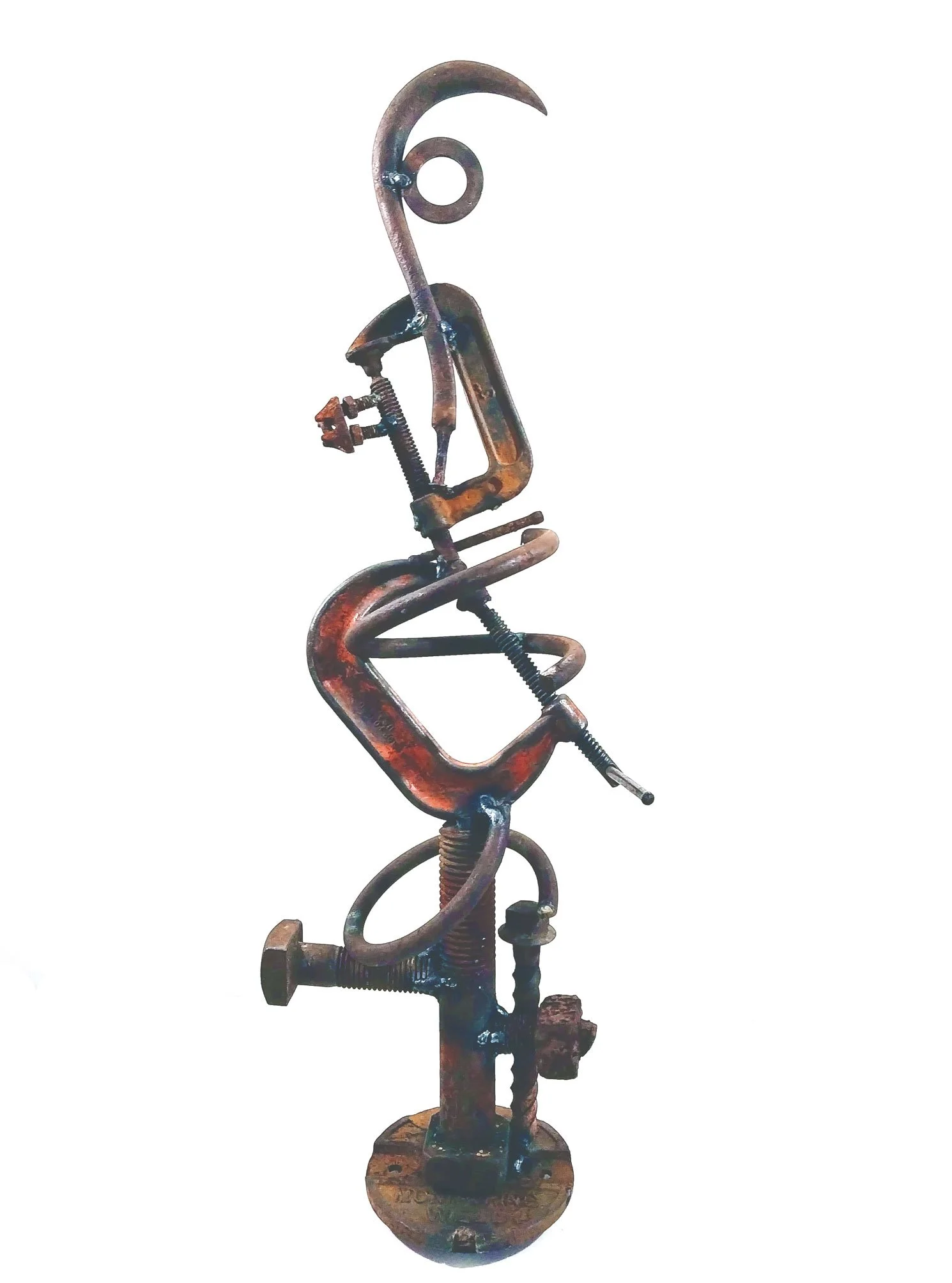
Untitled - 2025 - by Jerome China - courtesy of Jerome China
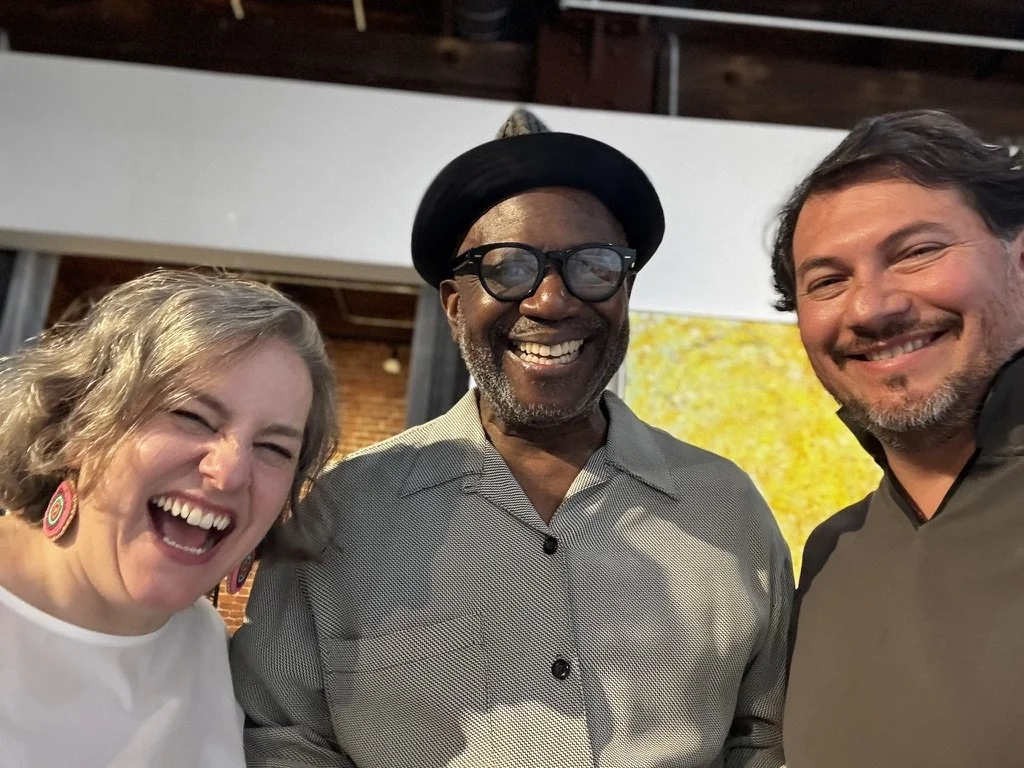
Jerome China - middle with artist Eleazar Sanchez and me at Novado Gallery -
Related Resources
Little Black Pearl - Chicago arts organization founded by Monica Haslip that teaches kids both art-making and the business of art, giving them public venues to sell work and learn about profit margins
"Hidden Footprints" - PBS documentary about famous Black people from Jersey City, featuring narration by Glen Cunningham
Tris McCall - Jersey City arts writer who included "Blackity Black" at Novado Gallery in his top 10 art exhibitions list
Explore Further
Coming soon on substack - an article inspired by my interview with Jerome - Subscribe so you do not miss the articles that go along with my podcast interviews.
Coming Up Next
Thank you so much to Jerome for such a thoughtful and inspiring conversation. As we head into the holidays, I want to thank all of you for listening and being part of the Sidewalk Stories community. This has been such an incredible year of conversations. I had so much fun starting this year and I had so many amazing guests from artists to historians, all sharing their connections to Jersey City and beyond, and I learned a lot, and I hope some of you listeners have learned or have been inspired as much as I have. I'm taking a short break, not very long. I'll be back with more stories in January. Until then, happy holidays. Happy New Year, and I'll see you in 2026.
Connect with Nat
Website: natkalbach.com
Substack: https://natkalbach.substack.com/
Instagram: @natkalbach
Email: podcast@natkalbach.com
Music: Our theme music is "How You Amaze Me," composed by Jim Kalbach and performed by Jim Kalbach, Bryan Beninghove, Charlie Siegler, and Pat Van Dyke.
Support the Show: Subscribe to the podcast and sign up for my Substack to receive additional stories and visuals that complement each conversation.
Share Your Story: What sidewalk stories have you discovered in your neighborhood? Share them with me through email or social media.
Nat's Sidewalk Stories explores the intersection of place, community, and storytelling through conversations with practitioners, community leaders, and local changemakers.
Full Transcript
Slightly edited for legibility
Nat Kalbach: Happy holidays everyone. Today I'm really thrilled to share a conversation with Jerome China, a metal sculptor who transforms his McGinley Square backyard into a sanctuary, both a creative space and what he calls the only place on earth where I don't have to compromise. Jerome's journey from needing a fence to becoming an artist, his Buddhist practice, and his connection to Jersey City make this a conversation about freedom, persistence, and the power of sacred spaces. This is a perfect episode to close out the year, a meditation on place, purpose, and artistic practice. Let's get into it.
Hi, I am super excited today to have Jerome China here as my guest. Hi Jerome. How are you?
Jerome China: Hi, Natalie. How are you? I'm well, thanks. Thanks for having me on the podcast.
Nat Kalbach: Yeah. I'm so happy to have you, Jerome. For those people who do not know you—people don't know me, I know, isn't that unbelievable? I'm just kidding. Can you tell our listeners a little bit about yourself, who you are, what you do, and in which neighborhood in Jersey City do you live?
Jerome China: So my name is Jerome China. I'm a metal sculptor. I'm based here in Jersey City and I live in the McGinley Square area, near Lincoln Park.
Nat Kalbach: Jerome, I know you were born in Richmond, Virginia and you moved between New York and Virginia, and then now you're calling New Jersey your home for a long time. So when did you become an artist? And can you tell us a little bit how that came about?
Jerome China: Well, I guess I declared myself an artist when I sold my first piece. I think that was probably around 2012, 2013. There was a commercial fabrication shop in Jersey City on Cole Street called All Iron Works. We commissioned them to do a fence for our house. When I went there to pay, I found out that they were making artwork out of scrap metal. And one of the things that I've always wanted to do now that I have a backyard is I always wanted to create a backyard sculpture. When I was thinking about creating a sculpture, I just wanted to create something. I had no idea it would be metal. But now that I think about it, metal is the perfect medium for outdoor sculpture. So that's basically how I got started. I spoke to the guys there. They said no a lot of times. I kept asking them and then they finally gave in. And I had six weekends—well actually it was only six days. It was one day on the weekend, like a Saturday. So over the course of six sessions, I finished my first backyard sculpture.
Nat Kalbach: Wow, that's amazing. So I want to come back to your artwork in some of the other questions. But one of the things that you told me when we were talking before was that you actually lived in Jersey City first time for like four years in the eighties, and then you moved away and you came back a couple years later, right?
Jerome China: That's correct. Yeah. So when I first moved to New York, I lived in the Bronx for about three months, and then I found my first apartment in Jersey City on Clinton Avenue between Kennedy Boulevard and West Side. So I stayed there for two years and then I moved on Bergen not too far from where I live now. I moved on Bergen between Belmont and Gifford as a matter of fact. So that was from like 1986 to 1990.
Nat Kalbach: Wow. And then you moved away for, I think you said like 2000 or something. Yeah, moved away for a very long time.
Jerome China: Yeah. Came back to Jersey City in 2001, I believe.
Nat Kalbach: What did change in those 10 years, if you recall? And how did that returning shape your connection to this place differently the second time around?
Jerome China: Well, the first time around I had no connection to Jersey City. Even though I was here four years, I spent all of my time in New York. So I had an apartment here, I would come here, change clothes, and then hang in the city. And once I started dating, I stayed with my girlfriend for months at a time. I literally had no connection to Jersey City. I would be gone for so long at times that I'd come back and electricity would be turned off. So I literally had no connection to Jersey City. Never went out in Jersey City, never visited. Lincoln Park was literally right down the street—never visited Lincoln Park, never went to Greenville, never went to downtown Jersey City. It was from my apartment on the bus to the city. And that was the extent of what I knew. And I think they had a few speakeasies back on Monticello where, I guess it was, where Morris Lounge is. I think they had a few speakeasies back there during the day. And I only ventured back there because I had a roommate who was like, let's go out for a drink. I found some places, but so back then, I had no connection to Jersey City at all.
The only reason we're here is my wife—my girlfriend then—she lived in Hoboken. We decided to buy a house and she wanted to be closer to the city. So I told her that I had lived in Jersey City at some point, so we decided to look here. We looked at two houses. One we didn't like because it would've been too much renovation for what we wanted to do. The house that we're in now, when we first looked at it, was under contract. So my wife kept saying, call back, call back, call back, call back. And we finally called back, found out that the house had fallen out of contract, came in. There were some things that we wanted from a property. We wanted a front porch, a backyard, and a driveway mostly. And those are the things that we got in this particular property. So that's the reason that we're here. Proximity to New York and transportation, it was affordable for us at the time.
Nat Kalbach: You've mentioned your backyard, which is amazing. You have your sculptures or some of your sculptures in the backyard, and I was so thrilled to have visited and we will talk about that too. But you have a studio in the backyard. I saw that you described your backyard studio as the only place on earth where you don't have to compromise, a sacred space. I love that. What happens when you step through that door? I am an artist too, so it's like I understand that for myself because I feel the same about my studio, but not everyone who listens is an artist, right? Like, what happens to you when you step through that door? What is the shift for you between that outside world and that sanctuary that you have in the backyard?
Jerome China: Before I go into my studio, I do take a little time to kind of meditate, to clear my mind, for about 15 minutes. I just sit in silence for the most part, even before I step through the doors. So being in the studio is a gateway from the outside world to me because once I'm in there, it's all about what I'm doing at the moment. So the outside world really doesn't exist for me anymore. And like I mentioned, it's literally the only place that I have where I don't have to compromise anything. So in relationships there's compromise. If you have a job, there's some compromise, basically just to get along with people. But when I go in my studio, I don't have to compromise anything. And having that kind of sacred space lends itself to be very, very fulfilling. And it's a really powerful space to be in, to know that you can be in a space where no one can tell you what to do. And that's—for me, other than not having the fear of living in a world that something could happen to me as a black man—that's a place of total freedom for me.
Nat Kalbach: Yeah, that's wonderful. Actually, I've never thought about it that way. That a place where you don't have to compromise. And also the freedom part. I mean, of course I cannot relate to the struggles being a black man in this world, right? But in terms of like the freedom of being yourself and don't have to answer to anyone and do whatever you want with your art and in your studio space. And it's true. I feel that way about my studio as well. You said you're meditating before you go into your studio. Is that a practice like a ritual that you came up with once you became an artist or did you—
Jerome China: No, we're a Buddhist household.
Nat Kalbach: Okay, gotcha.
Jerome China: We make it a part of our everyday ritual. It doesn't always happen every day. Sometimes we can go months without practicing, but this is a Buddhist household, chanting in the mornings or twice a day—chanting in the mornings and in the afternoon. It's something that we make a conscious effort to practice. Not always successful, but we do make a conscious effort. So I will do that before I go into my studio.
Nat Kalbach: Thank you so much for sharing that. You also said that art saves lives and that without that sanctuary of your studio, you wouldn't do so well.
Jerome China: So what I mean by art saves lives is that when I was growing up as a kid in Virginia, we had a lot of afterschool programs for kids, and the ones that I participated in were all art related. We painted, we did leather work. The people who were part of this co-op, if you will, they were all artists. So I learned how to take photographs, learned how to develop film. Part of this artist co-op, they had the first African American gallery in Virginia. They bought a huge house. They lived there. The first floor was a gallery. The second floor was bedrooms and a photography studio and a dark room. I grew up in a really cool neighborhood, but it was a neighborhood that I guess you would consider the inner city, if you will. And there was a lot of trouble that I could have gotten into. I have a lot of friends who didn't make it out. I had a lot of friends who, when I first moved to New York in the eighties, every phone call that my mother called, it was someone who died, got killed, whatever. And now when she calls me now, my first question is, what's wrong? So being in these afterschool programs geared towards kids in arts, that saved my life. If it wasn't for that, who knows what I would've been doing, but it was those afterschool programs, those afterschool art programs, that gave me an opportunity. It took me out of potentially compromising environments, hanging out with the wrong people. And so, based on where I came from, those programs definitely saved my life.
Nat Kalbach: Wow. Yeah. I don't know if you're mentoring younger people, but it's interesting because I was just—I don't know if you have been there and this is gonna air in December, so the election for the mayor has already happened when we are posting this podcast. Jerome and I are recording this now at the end of October. But I went to this art panel discussion of the mayoral candidates.
Jerome China: Was this recently? Yeah, at White Eagle Hall.
Nat Kalbach: Were you there?
Jerome China: No, I watched—they live streamed it, I watched as much as I could bear.
Nat Kalbach: Yes, I agree. There was some question about art education and what are your thoughts on that? I can say that I felt that the discussion was very unimaginative, but that's my opinion. That's not the person to be asked because you talked about how art saved your life and how you had this experience as a young person. And I also truly believe that art is so important for children and for young people. And there were one or two people of the candidates who actually talked a little bit about how important art for them was as well as a young person. Like what do you think could be done differently in Jersey City? What would it take to help young people to have programs like that?
Jerome China: So as you know, a few years ago, Jersey City now has an arts fund. It was one percent for the arts or whatever. So now, they've increased taxes on property owners. Not terribly, it wasn't anything that was horrible. But taxes were increased to fund this arts fund, and this art fund is used to support arts organizations in Jersey City and individual artists. Now the funding is for these arts organizations for programming only. So they can't use the money for administrative costs, like pay salaries, do fundraising, et cetera. So I think when it comes to arts for kids as a part of getting that funding—and probably some of them, some of them do—but as a part of getting that funding, there should be mandatory programs for kids. And a lot of them could be doing that. I don't know, because I don't really keep up with the arts organizations in Jersey City. There should be specific programming specifically geared towards kids. Maybe someone will come up with an afterschool program, very similar to the one that I was in when I was a kid, where it's an afterschool program that's basically geared towards the arts, so kids can go after school, have a safe place to be, and in addition, not only learn about making art, but also equally as important, learn about the business of art.
Nat Kalbach: Right. Yeah, the business of art, but there's also, I mean, it's so multifaceted, right? What you learn through art, like talking about art, communication, being in a group, right?
Jerome China: Yeah. Communication, being in a group. Problem solving, right? Exactly. Yeah. If you have to talk about your art, obviously that's gonna increase your speaking skills, right? Getting along with other people. Maybe there could be some classes in there about mediation as opposed to students lashing out. They can learn how to mediate their differences and come to a really good compromise that actually makes everybody happy. You're not gonna always get everything that you want, but if you can come to a reasonable compromise where both parties are happy—and let those people decide on what those things are, right? Usually you have a long lasting agreement between people.
Nat Kalbach: Yeah, great idea.
Jerome China: Yeah. And you know what's also been interesting, I've been reading a lot of how some places are helping kids manage their anger issues. And I think it's somewhere in California, I believe. As opposed to sending kids to detention if they're acting bad, they are practicing meditation actually in the schools. So they're literally taking 15 to 30 minutes out of their day. All of the kids meditate. And what they found out is the kids are more focused. So in addition to the art, I think in order to create—for me—you have to have a clear mind.
Nat Kalbach: It's interesting for me, art is almost like it is meditative too, right? I don't have to do art every day, I think, which is something that I discovered we have in common because you said that as well. And I have a lot of friends, artist friends that say, no, you have to go into the studio every day, nine to five. And it just doesn't work for me that way. But I do know when I crave it so much that I cannot—I have to go. And if I don't, if I don't follow that calling, it's not good for me and my soul because there is something in that when I'm in that zone in my studio where I'm feeling just so at peace and I'm just focused on that one thing. So that's so interesting that you talk about that meditation part too.
Jerome China: Yeah, so I think we did talk about how some artists feel like they have to be in their studio from nine to five. They have to do it every day. And so the only problem that I see with that is that that's the only thing that they have. Right. So if that particular thing isn't going right for them—they're not as successful as they want to be, they're not creating the work that they want to create—that's their whole world. So if that's not going right, nothing else goes right for them. It's kind of like the person whose identity is wrapped up into what they do. If you go out and do a survey and you ask someone, who are you? The first thing that they say is they talk about who they are as a professional. I'm a lawyer, I'm a doctor, but is that really who you are? Is that just a thing that you do for a living? You know what I mean? Right. No one goes, when someone asks who they are—no one, they don't go, well, in what context is that? The first thing that they do is talk about what they do for a living. So when I get asked that question—what do you do?—my next question is, what do I do for what? What I do to make money. There's what I do as a husband, there's what I do as a friend to people. What I do as an uncle, what I do as a son to my mother, et cetera. So I have to have clarification when people ask me that. So when people go, who are you? My first thought isn't, I'm an artist. I'm a lot more multifaceted than that. And if you just have one thing that you're doing, it's good to be laser focused, I believe. But I don't think that that's the only way to get to a place.
Nat Kalbach: We came to art in a later part of our life. Like you and I both had a profession before we became artists, right? So I think that's probably also part of that, that there's just more out there and I need that stimulation. I need other stimulation to actually to do my work.
Jerome China: Absolutely. I don't know about other people, but I'm interested in other things other than creating art. I love creating art, but I have other interests other than just creating art. And there are times when I'm not in my studio for months. I used to feel bad about it. Like I had to get in there because, being new to this to a degree, that's what I was fed. And now I absolutely do not feel that way at all. So I don't beat myself up if I'm not in my studio for a week or even a couple of months. It's just that I'm busy doing other things or, at that particular time, I just don't have anything to say artistically. And I'm not gonna sit in my studio for hours on end trying to force something. When I am in the studio, I produce a lot of work at one time. So I can be in my studio for days on end and, depending on the size of the pieces and the complexity, I can produce two or three pieces in a day. So again, I don't get hung up on that—I have to be in my studio every awakening moment of my life.
Nat Kalbach: We are different. There is not the artist, there's a lot of different artists, right? How they live and how they do and how they're inspired. Right. So when you pick up a piece of scrap metal and sometimes you do that actually from your neighborhood—that's not always the case, how you do it, but it happened. You talked about the scrap metal has its own history, from the creation to all the hands it's touched. Right now you are the hand that's touching it. How do you honor that history while you're giving it a second life in your work? And I'm gonna take it a little further. So you're giving the metal its second life. Do you ever wonder about a third life after it's going beyond your hands to someone else?
Jerome China: I feel that I give it its second life and I'm very, very respectful of the industrial revolution. I'm very cognizant of industrial revolution, like all the machinery that, when this country was a manufacturing country, when we actually made stuff. So I have an affinity for those kind of metal pieces. When you talk about a third life, you mean after something goes into the hands of a collector? I guess you could consider that—I guess you could consider that a third life because, or someone like taking—
Nat Kalbach: What would happen to it, like if someone would do something to it or, yeah. Is that the last life? Is the second life the last life? Or could it take another life?
Jerome China: It could take on another life. One piece in particular that I made, I sold it on a pedestal. Someone moved to another country and the base of it was, I guess, too big for them to put into their suitcase, and they took it off the pedestal and they put it on the wall. So once a piece leaves me into a collector's hand, I don't really have any attachment to the pieces. I've named pieces something and a collector gets it and they name it something else. And that's fine with me. It's how they see the work. I knew my intentions when I made it and why I named it that particular thing. But if someone wants to disassemble something or take it off of a base or name it something else, I don't care. I've done what I needed to do at that particular time with the materials that I'm working on.
Nat Kalbach: You said what you said.
Jerome China: Exactly.
Nat Kalbach: I like that. So you open your sculpture garden to your neighborhood, once in a while, and you let people know through your newsletter or—
Jerome China: Well, through my newsletter and through some social media posts. I'll post something. I have more colleagues on Facebook than I have on Instagram that I would consider fairly local. So I will post something on Facebook or dissect my newsletter and only send it out to local people because no one's coming from Australia to visit my garden. So that's the only how I get the word out. And then I'll usually have—because my network is only so vast—I usually encourage people to share it throughout their network because if I keep posting the same thing, I'm just gonna keep reaching the same people. And people have been really gracious of reposting things when I request that they do that.
Nat Kalbach: Of course, because they like your sculpture garden and that should be shared. So when people come to your place, and some of them are people that don't know you, right? Might be strangers or people that you have seen before, but maybe you're not like close friends or whatever. So when they come into your space, into your garden and they see the sculptures, are there moments when they saw your artwork in that space that stuck with you, that were interesting? How they react, what they see in the artwork?
Jerome China: I don't know if there is a particular time or one particular thing that stands out. Because most of the time when someone comes here, they're just overall surprised that something like a sculpture garden can exist in a space like this. And I have sculptures in the inside of my home too, along with the work that I collect. So when people walk through the backyard, then I invite them into my home. They're usually pleasantly surprised with all the artwork that's there, the furnishings and stuff like that. So I wouldn't say that there's one particular time where instances where something stood out. If you come here for the first time, you're pleasantly surprised.
Nat Kalbach: Yeah, I can attest to that. Not only your artwork, but also the immense and amazing art that you and your wife have collected.
So different topic. In 2022, Anne Novado from Novado Gallery gave you an open slate to create a show of contemporary cultural importance. And you brought together, I think like 10 artists that were in different career stages for the show that you called Blackity Black. Can you tell us a little bit about the exhibition and how it resonated and what did curating a show teach you about your own artistic journey if it did?
Jerome China: So what I realized is that I'm not a curator. I think someone wrote an article that made a lot of sense to me. Just because you have a space and get together a group of artists, it doesn't make you a curator. Some people are academically trained to be curators. They're art historians. So I now look at it as me not as a curator, but as a person who produced an art show. When I got the opportunity to do Blackity Black, when Anne approached me, I knew I wanted it to be an abstract show, and I also knew that I only wanted people of color in the show. Because even though some of them were in different stages of their careers and some of the people that decided to sign on when I asked them I was totally honored and surprised that they would even say yes. But I wanted to showcase African American artists for that particular show. And I also wanted the show to be abstract as well because so that it could potentially appeal to a broader audience of people, because abstract is abstract. If someone does an abstract painting, I guess it depends on the elements that are in the painting. Sometimes it can be very, very difficult to determine the nationality of that particular artist. You may be able to determine by the color palette that they use or different symbols in the work, et cetera. But I wanted it to be an abstract show and I wanted to introduce those artists to a new collector base for them. So the show is all about them. Anne asked if I wanted a piece in the show and I told her that any shows that I produce, other than in my own space, I would never put myself in the show because I want the attention to actually be on the artists. It got really good reviews. The openings—we did a lot of programming around the event that turned out really well. And surprisingly enough, someone sent me a link—Tris McCall.
Nat Kalbach: Mm-hmm.
Jerome China: The Jersey City art beat writer, if you will. He's probably more than that, but he writes about the arts in Jersey City, what's going on a lot. Someone sent me an article and surprising enough, it made the top 10 list of art exhibitions for that year. I think we came in at number seven, which just totally blew me away. It was an interesting experience. The professionalism of some artists, when it comes to meeting deadlines and delivering work. I mean it wasn't a huge problem. I had to kind of nudge some people, but I kind of got a sense of who is used to showing and who's not used to showing.
Nat Kalbach: Yeah, I think that's an interesting thing because you mentioned that earlier as well, when we were talking about art education for younger people and you were talking about the business side of art education as well. And I've heard that from other curators, but also, I used to do art education and I used to have an online platform where I used to invite 30 other artists every year to do an online course for thousands of students. Right. And it was very interesting who and how would also understand that this is also business. Right. Like, it's hard maybe for people that don't know that everything is connected, right? For a show. There's not just you're throwing your work into the space where it's gonna be hung, right? It needs to be hung, it needs to be decided where it goes, it needs to be labeled. There's a lot of that.
Jerome China: As in your recent exhibition, you have to have programming, right? You just can't have an opening and a closing, right? You have to have programming to help drive traffic. One of the most successful art programs that I've seen is in Chicago. There's an arts organization called Little Black Pearl. Started by this woman, Monica Haslip. And when I first met her, she had a townhouse. Her whole program was actually in her basement where she—and at that time it was teaching kids mosaic, they were working with clay. So eventually she got a building from the city of Chicago for like a dollar, and she renovated the space and now they have this amazing organization called Little Black Pearl. And what impressed me the most is that not only do the kids make artwork and they have instruction, et cetera, but she's also teaching them the business of art. So when they make their art, it's just not sitting at Little Black Pearl. They have these venues where kids get tables and they're public facing and they're selling their art. And they're learning about things like profit margins, that kind of thing. So that was one of the first programs that I saw where it was a combination of make art and also this education about art as a business. So that was something that really impressed me. Yeah. And it's an amazing organization now, it's been a pleasure to watch them grow as they have.
Nat Kalbach: I have to link that up in the show notes. That sounds amazing. Yeah. Little Black Pearl.
Jerome China: Little Black Pearl.
Nat Kalbach: Very cool. Last question. If you could spend an afternoon with anyone from Jersey City's past who would it be? Which corner would you choose as your meeting point and what one question would you ask them?
Jerome China: Hmm. So Jersey City had its first black mayor. His name was Glen Cunningham, who I think died within a year. I don't even think it was a year that he was in his first term. It was soon after that. And I remember meeting him. There was some school meeting at a school on Bergen Avenue. I think it's PS 17 now, but it was something else. And I remember walking up to him and I asked him a question. I think I had an issue with, why do we have so many liquor stores on the corners in this particular neighborhood? Because I think I walked a three block radius and I found maybe seven to 10 places where you could buy liquor at the time. So when I talked to him about that, he literally gave me eye contact, and he was like, well, that's something that we can discuss. Call my office. So it would probably be him because he was a Jersey City guy. He was a Marine, I think he was a state trooper, I believe. And I think that he was about to do really good things for Jersey City before his death. I guess the question I would ask him is, what do you think about Jersey City now? And what was your vision for Jersey City if you could have lived out this term? So it was a huge thing for Jersey City to have its first black mayor. I don't know what he would've become, but it started out to be fairly promising. I don't know if I'd have it on a street corner. We'd probably sit on my front porch and chop it up, or go in the backyard.
Nat Kalbach: What a great person to name and what a great question. Amazing. I love that. And I know of him because I actually pull him up sometimes for my research because he did this short film for—was it PBS, I guess—I think it's called Hidden Footnotes about famous black people from Jersey City.
Jerome China: I think I remember seeing that years ago. Vaguely. I know that. Yeah. He did the narration and talked about it. I think I remember seeing something about that, but that was years ago that I believe I saw that video.
Nat Kalbach: I will find it and we will put it in the show notes.
Jerome China: Yeah. But he would be the guy that I would like to have a conversation with.
Nat Kalbach: Very, very cool. I had such a great time as always talking with you, Jerome. I will also link up places that people can connect with you. Are there any upcoming shows that you're able to tell us about?
Jerome China: Yeah. I have an exhibition coming up in February. The work would be available to see on February 19th at this place called Hudson Guild in New York. It's their secondary gallery on Ninth Avenue, and that's gonna run February 19th through April 15th of next year. And I've also just been offered a solo show in Trenton in June that I'm still finalizing everything. But that's gonna happen at this place called Art Works Trenton in Trenton, New Jersey. So I'm very, very excited about those two exhibitions. And I may have another opportunity to curate something at Novado.
Nat Kalbach: Cool. I can't wait. Can't wait for the first one in February. I will be there.
Jerome China: Yeah, it should be pretty exciting. It's a small gallery. I'm only gonna show probably maybe 10 to 12 pieces because the space is small, but it's in Chelsea. It'll be my first solo show in Chelsea, which I'm really excited about. And just glad I have an opportunity to do it.
Nat Kalbach: Thank you so much, Jerome. That was amazing and I had a good conversation with you. See you soon.
Jerome China: Yeah.
Nat Kalbach: Thank you so much to Jerome for such a thoughtful and inspiring conversation. You can find Jerome's work on Instagram. I will link it up in my show notes. And if you're in New York City or in Jersey City or close by, definitely check out his solo exhibition opening February 19th at Hudson Guild in Chelsea. As we head into the holidays, I want to thank all of you for listening and being part of the Sidewalk Stories community. This has been such an incredible year of conversations. I had so much fun starting this this year and I had so many amazing guests from artists to historians, all sharing their connections to Jersey City and beyond. And I learned a lot, and I hope some of you listeners have learned or have been inspired as much as I have. I'm taking a short break, not very long. I'll be back with more stories in January. Until then, happy holidays. Happy New Year, and I'll see you in 2026.
