
Episode #216: Preserving Light and Memory with Zach Green
About This Episode
Zach Green's relationship with stained glass began in Lambertville, where a mentor told him to "get out of this town," and led him through Zanzibar's Batik workshops to Jersey City's historic windows and the legendary 111 First Street artist studios. In this conversation, we explore how growing up in Trenton taught him to see beauty in broken things, why stained glass restoration is an endangered art form, and what it means to work with light as spirit. Zach shares his journey from living on a sailboat while creating art to receiving recognition from the Jersey City Landmarks Conservancy, his philosophy of teaching stained glass to everyone from fourth graders to 90-year-olds, and his melancholic but honest reflection on what we've done to this place we call home.
Meet Zach Green
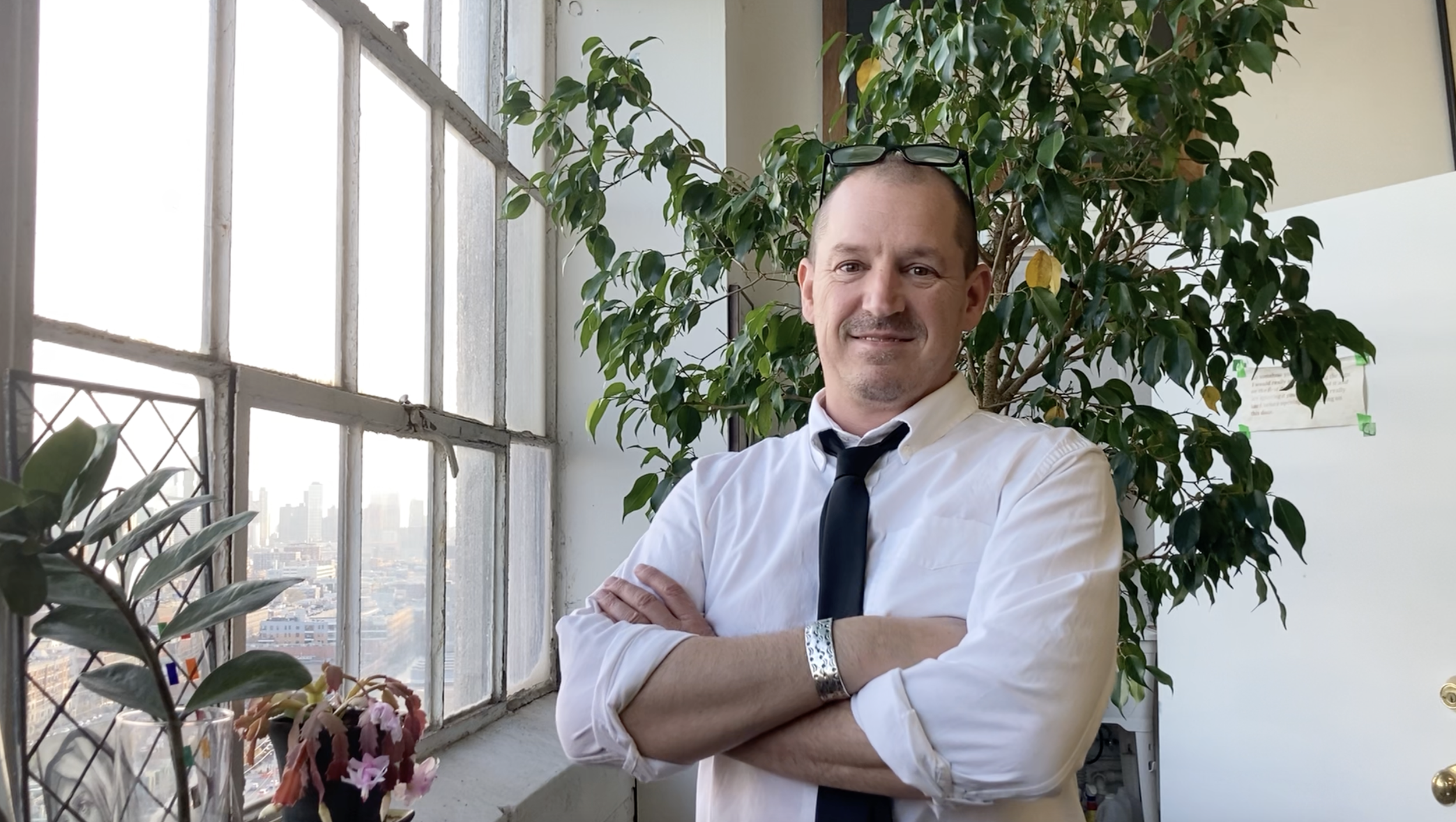
Zach Green is a stained glass artist and restorer who has been working in Jersey City since 2003. Originally from Trenton and the Princeton area (born in Flemington, New Jersey), Zach studied at Rutgers University and learned his craft from a mentor in Lambertville. His work spans historic restoration of rare Stained Glass windows and community teaching, creating accessible stained glass workshops using safe materials for students ranging from elementary school children to 90-year-olds. He is part of Jersey City's artist lineage who worked in unconventional spaces, having lived on a sailboat while sharing a studio at 111 First Street before the building's demolition. Recently, Zach received an award for Craftsmanship from the Jersey City Landmarks Conservancy for restoring a Belcher Mosaic window. He is also a musician, playing in the band Twisted Martini with Jim Kalbach, Elena Zazzanis, and Ryan Fried.
Connect with Zach Green:
Website: The Gil Studio, Inc.
Instagram: @thegilstudioinc
Band: Twisted Martini (with Jim Kalbach, Elena Zazzanis, and Ryan Fried)
Key Insights
Zach's ability to see beauty in "scruffy" places was shaped by growing up in Trenton, watching his father restore a rowhouse, and learning to recognize the grandness that once existed in forgotten colonial cities
Batik art in Zanzibar became his "shortcut" to investigating stained glass—using wax and fabric to understand how light passes through color before committing to the more complex medium of glass
Belcher Mosaic glass, made in Newark for just a few years in the early 1890s, represents a rare form of stained glass found in Jersey City's historic brownstones—a piece of local manufacturing history preserved in windows
Stained glass is fundamentally a community art form—from fundraising to designing to building, windows exist through the collective effort of many people and belong to everyone who contributed
The craft of stained glass restoration is endangered: manufacturers are disappearing, few young people are learning the skills, there are no formal training programs, and knowledge is literally dying off with practitioners
Teaching stained glass across generations reveals a universal truth: "Light is spirit and you can feel it"—whether you're 9 or 90, there's something elemental about colored light passing through glass
Zach's teaching philosophy centers on creating safe, accessible versions of stained glass that allow groups of 100-200 people to collaborate on large windows, building community through collective creation
Growing up, Zach witnessed Trenton demolish two entire city blocks to widen Market Street—a formative experience that shaped his resistance to disposal culture and commitment to restoration over replacement
His melancholic perspective on Jersey City's transformation reflects a deep consciousness that "we're walking on a conquered people's land" and a wish to go back to the city's beginning to witness "this place in its infancy, in its primacy"
Visual Documentation

The Gil Studio - Zach’s Studio in Union City

Work in Progress

Our Belcher Glass Window before Restoration - sagging, pieces missing, patches of former repair approaches of previous owners with tar.
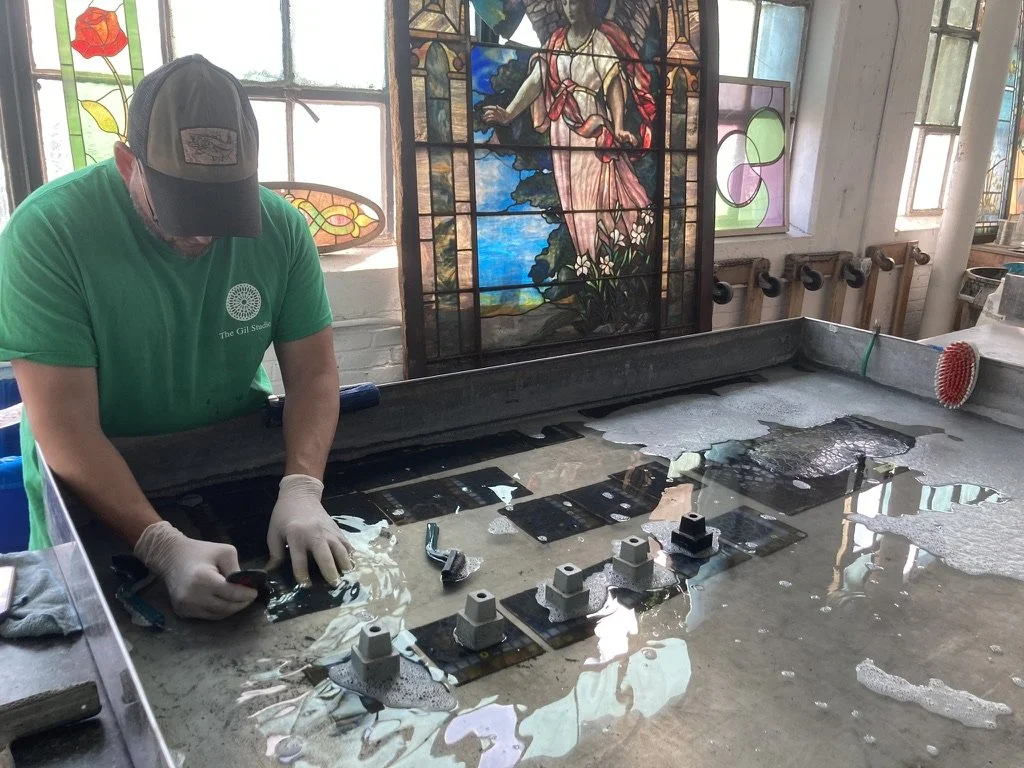
During the restoration at the Gil Studio - first a nice bath

Coming back home - she is beautiful!

My stained glass project I did with Zach in his studio - here at the Museum of Jersey City History
Coming Up Next
My next guest is Jerome China - a sculptor and collector of art -I cannot wait to have you hear this conversation.
Connect with Nat
Website: natkalbach.com
Substack: natkalbach.substack.com
Instagram: @natkalbach
Email: podcast@natkalbach.com
Music: Our theme music is "How You Amaze Me," composed by Jim Kalbach and performed by Jim Kalbach, Bryan Beninghove, Charlie Siegler, and Pat Van Dyke.
Support the Show: Subscribe to the podcast and sign up for Nat's Substack to receive additional stories and visuals that complement each conversation.
Share Your Story: What sidewalk stories have you discovered in your neighborhood? Share them with Nat through email or social media.
Nat's Sidewalk Stories explores the intersection of place, community, and storytelling through conversations with practitioners, community leaders, and local changemakers. New episodes release on the 2nd and 4th Thursdays of each month.
Interview Transcript
Nat Kalbach: Welcome to Nat's Sidewalk Stories where we explore the hidden histories and creative spirits that shape Jersey City streets and buildings. I'm your host, Nat Kalbach. Today I am talking with someone who quite literally brings light into our city. My friend Zach Green, a stained glass artist and restorer who's been working in Jersey City since 2003.
Zach is one of those rare artists who bridges the past and present. He restores historic windows that most of us walk past every day without realizing their significance. Like the intricate Belcher mosaic glass you might spot in some of the historic brownstones. They were made in Newark for just a few years in the early 1890s. But he's also a teaching artist who's figured out how to make stained glass accessible to everyone from fourth graders to 90 year olds.
What I find most compelling about Zach is how he sees beauty in broken things. A sensibility shaped by growing up in Trenton, watching his father restore a row house and learning to recognize the grandness that once existed in forgotten places. He's part of a lineage of Jersey City artists who've made their studios in unconventional spaces. He even lived on a sailboat while sharing a studio at the legendary 111 First Street building before it was demolished.
In our conversation, Zach takes us on a journey from his early days studying with a stained glass mentor in Lambertville, who actually told him, "get out of this town" to discovering Batik art in Zanzibar to his current work, trying to preserve what he calls "endangered art."
We'll talk about what most people don't understand about stained glass, why church windows tell us so much about community history, and Zach's somewhat melancholic, but deeply honest perspective on what we've gained and lost in Jersey City.
Hey, I'm so excited to be here with my friend Zach Green. Zach, so good to have you. How are you?
Zach Green: Thank you. I'm doing very well on this rainy Monday afternoon.
Nat Kalbach: So Zach, for those people who don't know you, can you tell us a little bit about you, what you do, where you are, and what's going on with you?
Zach Green: Yeah. I've been living in Jersey City since 2003. I've been working in the field of stained glass since then, and even a few years prior to that. I'm originally from Trenton and the Princeton area. I was born in Flemington, New Jersey. So I've been around Jersey for a long, long time.
Right around 2001 I started doing stained glass, and studied art at Rutgers. And when I finished that degree, I headed up to Jersey City and set up a studio and started working. So, I've been around those blocks a few times now.
Nat Kalbach: What's your first memory of being actually captivated by light through glass or the glass? Did you do that in art school? Did you do that at Rutgers too? Or how did you stumble across it and how did those different places where you lived, did they have any influence on that?
Zach Green: That's a really interesting question for me. I did try to do stained glass at Rutgers and at the art school there, Mason Gross, they sort of frowned on it and they said, "oh, you know, stained glass, that's not art. It's nice, it decorates our houses, but it's not art. You can't really do that here."
And that really drove me to keep going. But let's see. When I was growing up in Trenton, some family friends lived nearby, a few blocks away, in another little row house in a scruffy little neighborhood. And the guy in that house was a stained glass artist. So I grew up visiting his studio, visiting his house, and he's just a family friend from those early days in Trenton who was always working in that medium. And then I was always transfixed by that stuff.
And he was a really important person in my life. He was a musician and an artist. He was the person that made me see that that kind of life was possible. That you could commit a good amount of yourself to pursuing the arts and those kind of intellectual adventures. And so I always knew that some day I was gonna try it.
I did a lot of theater as a kid and I did a lot of music as a kid. And the visual arts came to me a little later in my mid-late twenties. When I was finally ready to start, I sort of knew that stained glass was something that if you were gonna do it, you had to do it. You had to really jump in with both feet. And so I waited until I was ready to do it, and it was my late twenties.
And I went and visited him and asked him if he would teach me, and he did. So I had about a year of working with him and figuring out what the basics were. And then he said, "okay, off you go and don't ever work in this town in Lambertville. Get outta here. Start your own studio. Don't you ever work in this town." I was like, "all right, I get it. This is kind of gangster." Stained glass gangster. And so, yeah, from there, using him as my model, set up my studio and carried on with it.
Nat Kalbach: That's really cool.
Zach Green: Yeah, so it really came from my earliest memories in the city of Trenton visiting his house and his studio up in Lambertville. It's all interconnected into the web of my early life. And it came out of all that.
Nat Kalbach: How did you feel when you were trying to do something with that at Rutgers and they were snuffing at it as more as a decorative art? That's kind of weird, isn't it?
Zach Green: It was very strange. Yeah. And I should not say, I should not brand that with Rutgers. I mean, there were some great professors and instructors there who loved the things that I was trying to figure out and experiment with. They loved, they sort of understood that there's art in every craft and there's the craft part of every art. And those things are the left and right hands of each other.
But I remember one professor who I admired a lot, and I still do, she was great. But she said, "no, no, no, that's not gonna happen." And she like fell. I saw her fall in my esteem. She was top down from that cloud and splatted onto the ground at my feet. And I was like, "okay, moving on."
But no, Rutgers was an amazing and very supportive place overall. And in general, I had some amazing professors, some of whom I'm still friends with. Excellent place. Rutgers.
Nat Kalbach: I mean, yeah. My household, as you know, Zach actually plays with my husband in a band. And my husband also went to Rutgers, so there's a lot of connections and I would never say anything bad about Rutgers. Of course.
Zach Green: Big Red. Go, Big Red.
Nat Kalbach: You also spent some time in Zanzibar, and you studied Kiswahili.
Zach Green: Yes. Swahili, that was the language there. In Swahili, you call it Kiswahili. But yeah, we in English, we just call it Swahili.
Nat Kalbach: How did that experience to learn the language and be there shape your approach to learning or to craft and teaching?
Zach Green: It did actually, in a lot of different ways. But most directly, the thing that comes to mind first is that in my early twenties, I was messing around with Batik, you know that art form where you melt wax into fabric and then dye it and you can do it in different layers and people commonly make clothes and tapestries and stuff, decorative stuff like that.
And I was really transfixed with all that, how the light passes through it. And for me, there was a really strong connection between light passing through colored fabric and stained glass. But a Batik you could make in half an hour, whereas stained glass was this whole program that I hadn't touched yet that I knew I wanted to. So it's funny, I was using for a few years, Batik as a shortcut to investigating stained glass. And so I made lots and lots of artwork. I made Batiks that literally just resembled stained glass panels and I mean awful ones. But it was a start. It was where it started.
And then when I went to East Africa, right at the very beginning when my first few days in Zanzibar, I met this artist. Well, actually I just saw this piece hanging on this storefront. This little painting that I thought, "what in God's name is that? It looks like Batik, it looks dyed," and I felt it, and it was covered with wax. And I thought, "this thing is just absolutely magnificent. I've never seen anything like it, the detail, the rendering of architecture."
And these old stone, it was a picture of a person walking down these old stone streets. And there was this, the Minaret from this mosque like spiraling up into these clouds of swirling colors. And all of this was rendered with wax and fabric and great, great detail. I mean, the expression on the face was there. It wasn't this crude kind of splotchy hippie looking stuff that I had seen people make, you know, like at Grateful Dead concerts. It was like this really refined and totally expressive artwork made in Batik.
And so I took the thing up to, took it off the wall and ran up to the guy and said, "did you make this?" He said, "no." I said, "do you know who made it?" He said, "yes." I said, "can you take me to that guy?" And he said, "yes." And so I bought it, I think it was like $20 or something.
And he walked me through these alleyways, through the same alleyways that were in the picture, like we're walking through this dreamscape of ancient Zanzibar. And he took me to this other little shop and this guy sitting in the back, he was painting something and the guy said in Swahili, "Omar, this white guy wanted to meet you. So I brought him to you."
So I met Omar and we became fast friends and I held the thing up. I said, "did you make this?" He said, "yes." I said, "we're gonna be friends." He said, "okay." And I said, "can you teach me how you did that?" And he thought I was kidding. But I actually had wax in, I had a bag on my shoulder, I had wax in the bag, and I had some dye.
And I said, "look, I have my own stuff. I'm serious. I'm not kidding." And so we became fast friends and we're still pals, 25 years later. But so for me that was when I got serious about image making and trying to use colored light in a serious way. And when I got back the year, about a year later when I got back from Tanzania is when I called my friend Don and asked him if he would teach me stained glass.
So it was a really strong and direct transition that experience with Omar and that year of working with him. We made a lot, a lot of artwork together and it was amazing.
Nat Kalbach: That's so cool. Do you still have that piece?
Zach Green: I have it. Yeah. Yeah. I should hang it.
Nat Kalbach: Do you have a photo of it?
Zach Green: I don't have a photo of it, but I have it. It's in a roll with a bunch of other pieces. I'll show them to you. They're magnificent. You would love them, Natalie. They're really special things. I have a bunch.
Nat Kalbach: That's so cool.
Zach Green: Yeah.
Nat Kalbach: It's interesting that you say that. Of course I'm not a stained glass maker, but I used to make stencils, stencil designs, and I've always been fascinated by Batik too, because there's something about the positive and the negative, the spaces, the bridges in between. And then stencils remind me of stained glass, of course, because the lead, you know, so it's, that's, for me, that makes total sense. That's all kind of connected, those three things.
Zach Green: Yeah. And that Cloisonné technique with enamel and copper, where you have these little copper wires where you melt the enamel in between the little segmented copper spaces. Like I don't know why I love that stuff.
Nat Kalbach: Yeah, that's cool. What a great story. I love that. The other thing that I discovered about you that I didn't know, which is kind of odd, but I actually realized that when Tris McCall wrote about you in an article because you just got an award for Craftsmanship from the Jersey City Landmarks Conservancy.
And I had talked about this with a couple of guests, which is the 111 First Street, and apparently you have been a former tenant there when it still existed. The artist warehouse, the original Heart of Arts. What was your experience being there, working there? Tell me a little bit about that and how did that community shape your path as an artist, a musician? Maybe it's not true that you were there?
Zach Green: Yeah, it's nonsense. I was never there. I'm kidding. No, I was there for the last couple years that it existed until everybody got handed the boot. And it was pretty amazing place. I mean it was like five, five floors of every kind of person you can imagine, with these cavernous art studios and people raising families in there for generations.
For a couple hundred bucks you could rent like a 5,000 square foot, three story place with like, you know, massive windows and you could hang swings from the ceiling and play basketball in your living room. It was just an amazing, amazing place. Jersey City was a different place at that time.
I shared a studio there and so I didn't live there like a lot of people did. I would like to have lived there. I'm probably lucky that I didn't. But it was an amazing place at the time. I was still trying to figure out how to exist in Jersey City. And I'd found a sailboat up in the marina at the end of Marin Boulevard that this guy was willing to let me live on. So I lived in a sailboat and had a studio at the 111 building. Like the most Jersey City thing.
Nat Kalbach: I knew the sailboat story, but I didn't know that you were, you had a studio or shared a studio at 111 First Street. That's so funny.
Zach Green: Yeah, I mean, the people that I shared a studio with were very highly professional and very serious craftspeople that made objects. Their studio was called ICBA, which stood for "it can be anything," right? It could be anything where they literally could do, they literally made anything for anyone. They made props for movies.
If you remember the Malcolm X film with Denzel, the Spike Lee movie, and it opens with this American flags slowly burning into an X. So these people there made that X that would burn. So they put fire retardant on the flag where the X was, and then they torched it and the thing burned, burned, burned. And then when it got down to the end, there was this X that wouldn't burn out of the center of an American flag. Like these people built really amazing stuff for all kinds of clients and just seeing that there were people that had the creativity to solve problems like that, out of materials and to do it there in Jersey City in real time with the people that they know, with just teamwork and cleverness, was huge for me.
I mean, there were other kinds of people in that building. It was just a really wild place. But my place in that building was through these kind of serious, serious people that did well. They were fabulous. And I'm so fortunate to have been able to be there and be around the people making it work. They lived there and put their lives together and sorted it all out in a landscape of Jersey City, which was starting to change really fast.
When we all got the boot from that place, everybody had to scramble and find a new place to set up. And it was sort of like when Don sent me packing from that first stained glass studio, I said, "okay, out you go, go set it up. Don't ever work in this town." But anyway, everybody's scattered and it's nice to run into people that were there and know what that place was like. And there are a few survivors that are still around. Not too many, but there's a few.
Nat Kalbach: That is so cool. I feel like because you were, in that same award that I just mentioned, you was actually our stained glass window that you restored and there was a lot of problem solving involved because it was made in a way that is very different from other stained glass windows, with teeny tiny little, almost mosaic like pieces. And no one knows how these windows were made, but you solve the problem of saving it and making it work for the next couple hundred years. So that's so cool that you mentioned that you were around these professionals that tried to figure things out and were so creative and problem solving, and I feel that translates to what you do nowadays in your own practice.
Zach Green: I think that's true. I look back on those people and they were just versed in all kinds of materials and the intersection of different kinds of materials and it was just fascinating. And if you needed something in that building, you could go upstairs and there was somebody who did exactly what you needed or go down to the hall or go talk to this guy on the third floor. He knows how to do it and he's got the tools and everybody was this hive of mixing and mingling. And it was a great incubator.
So I'm up in the Yardley building, which is in Union City now, and it's like a mini, well, it was like a mini version of that place and several of the people from 111 wound up up at the Yardley building back at that time. Back then there were more artists and it was a little more, little more of a ragamuffin kind of scene. Now there's some bigger companies and more serious stuff there. But the Yardley is another incubator where people help each other out and share projects and work.
I've learned a lot in all these places, and that's part of what's so amazing about Jersey City is it's where the action is. It's where the interesting people are. And I mean, there's interesting people in other places, but there's a lot of them all in one place in Jersey City. So just a great community. I never expected to be here this long, but here we are.
Nat Kalbach: Yeah, you're still here. Thank God. I love it.
Zach Green: Yeah.
Nat Kalbach: In terms of stained glass, since we're talking about it, can you walk us through what most people that have never really thought about stained glass? What might people not know or understand about stained glass restoration versus making stained glass, like making your own?
Zach Green: Making new work. God, where do I begin with that? That is a small question with a really big answer. Stained glass is a really brutal and sort of stubborn material glass. It's unforgiving in a lot of ways. And if you push it too far, it breaks and goes in the trash.
So there are a lot of different ways to manipulate glass and we sort of have to start at the beginning and learn this strange set of steps about all of the different elements and the ways to transform glass from one form into another. And I mean, I don't make glass. I buy sheets of colored glass and then I cut them up and use them in projects. But there are glass makers obviously who make it, and that's a whole other procedure, process and vocation.
But as stained glass goes, I buy sheets of colored glass and cut it up and transform it and bend it and recolor it and stain it and paint on it and heat it up and cool it off and break it and then reassemble it in a myriad of different ways. But the general idea is that you have, well, first of all, stained glass 90% of the time is a functional window. It's really where art and architecture intersect. It has to be functional, keeping the weather out, keeping the heat inside of your building. But it's a moment to decorate your building. It's a place where art happens and interacts with the light. And that's the beauty of windows is that it lets the outside in, but in a controlled way. And stained glass addresses that portal with additional thought. You put all kinds of intention into a design of a stained glass window.
The materials is really challenging. It takes a long time to learn how to deal with that. And we still use lead. It hasn't changed much in the last thousand years. We put the windows together with lead and we try not to eat it or breathe it too much. And if we're taking apart old windows, we've gotta be really careful because the materials can be pretty toxic. And so there's a big safety element. Not to mention slicing your fingers up and going through boxes of bandaids every week. It's a whole world. It's a whole universe.
Nat Kalbach: So you have described spending time in buildings covered with bird shit and trying to fix stained glass windows. And then sometimes the windows look pretty sad and dull. What's your relationship when you're in this like kind of gritty reality and then there's this beauty? Do you see that right away when you see a window? Do you see how that's translated into, "I'm gonna take care of you and bring you back to life?"
Zach Green: That's another great question. I think this also goes back to my early childhood in Trenton. And if you've never visited Trenton, it's still a really scruffy place, right? It's one of those East coast New Jersey colonial cities that had a great period with lots of prosperity and industry and it had glory days. And during those glory days, amazing things happen in places and things get built. And you know, Jersey City is seeing a lot of those things getting rebuilt.
And when I was a little kid growing up in that city, I came from my father working on a house there and restoring an old row house back to a really refined state, going from partially collapsing to being a real showpiece. And I grew up literally in that house as the construction was happening over 10 years and learned from him about how to work on buildings and how to turn old, crumbling things, how to bring them back to life. He was a restorer of stuff and still is. I mean, we still do projects together where we, you know, got an old feature of the house or, and cars, we've worked on cars together for a long time.
It's, that stuff is a sensibility that I got from him. And I still, when I drive through Trenton occasionally, it's one of those places where you can drive down, you know, Broad Street and see that this was once a grand place and you can see the lost potential over the years. It's not to take anything from the people that are there now living their lives, but you can just see that there was once a sense of opulence and optimism and sort of, I don't wanna say greatness, it's the wrong word, but grandness.
And so, you know, Jersey City is another one of those places where you cruise some of the streets and you can just tell this place used to be something else. I see things through that lens and always have. And so stained glass is just a part of that. It's one feature in a landscape of things that look that way to me. So, yeah, I see the beauty in broken old things and the potential, always have. And I guess I always will.
Nat Kalbach: I love that you say that. I have that too, that I see a lot of beauty in grittiness or in things that other people may say it's old and broken down. And the connection that we both have is that my stepfather bought this house from the 1500s in Germany, and it was basically like, there was no heater. We didn't have a doorbell. I mentioned that on a different podcast with Chelsea. We had a cowbell. I had a huge key, like six inches long, a skeleton key, because the door was an old oak door that could hardly be open. It was never finished because, you know, it was an old farmhouse and it was in a pretty rough state.
But maybe that is like, you have that with your father and maybe part of coming up with people who are showing you that you can change things and can bring things back or, you know, not everything is what it looks like or it's about how what we make out of it again, or make out of it. So it's an interesting parallel. I would love to explore that if there are more of us out there that we always see some potential in something that might look gritty and ugly for others, maybe.
Zach Green: Yeah. I think in part it's a resistance to this disposal culture that we live in. Things are just not meant to last. They're meant to be used for a while and then tossed and replaced with something new. I was sort of bred to resist that.
I have to say, there's a funny anecdote about that neighborhood in Trenton. When I was five years old when we moved there, so within a year or two, the city planned to demolish two city blocks entirely, completely demolished them to widen Market Street. And there were, I don't know how many houses, many condemned houses. Once they were finally all emptied of their people, they were slated to be knocked down.
And I don't have a memory of this, but I remember my father doing it. He, and talk about brave, that sounds just terrifying. But he went through a lot of these old houses that were about to go under the wrecking ball and scavenged and salvaged materials like old light fixtures, and wrought iron gates and just interesting stuff, doorknobs, for his house that were gonna just be pulverized and put into dumpsters and carted away. And so our house wound up being sort of extra decorated with some of those things, because he had the courage to go into those houses and see what was in them.
He takes some old stuff and polish it up. It can be amazing that, you know, once that stuff's gone, it's not coming back. So I feel that way about stained glass too. All of it. Save all the stained glass people. Save it all.
Nat Kalbach: I love when I ask you or other people ask you about any windows in Jersey City. It has a pretty incredible collection of historic stained glass. I wasn't aware before that there were so many houses with, for example, Tiffany stained glass windows or you know, the Belcher mosaic glass in our house. When we discovered that and you helped us restore it and also our neighbors, now I can spot it in other houses and I'm like, "wow, that's crazy. That kind of glass was only made for a couple of years in Newark and that's so special." Do you still walk around like Jersey City and you see stained glass windows and be like, "oh, this must be, oh, that's cool." Like, do you see them still? Do you seek those windows out?
Zach Green: Oh yeah, I do. I mean, most of the magnificent stained glass is in churches, and churches aren't open like they used to be. Churches used to be open every day, and you could walk in and take a few minutes for yourself. But churches are now only open for a couple hours one day a week most of the time, and it's hard to get into them. And so it's not as easy to stop in and see the stained glass that you've been driving past for decades.
I can't get enough of the stuff. It's really weird how hooked I am on it, but I'm definitely obsessed. I'm such a super nerd about stained glass. I wanna see it all. Yeah, I mean, at this point there's a lot of generic stained glass made in the turn of the last century around that time too. There's a lot I walk past, but I can usually tell from the outside whether something's gonna be special from the inside.
Nat Kalbach: Yeah. And it also tells you so much about, that's something that I definitely learned from you as well. We both went to Saint Michael's Church next to the Barrow mansion. And looked at the stained glass window. You took me with you because it's a former German church and there was a lot of German quotations on the windows. That was pretty cool.
And then I also went to the church on Ivy Place. And so it was very interesting for me to also learn about how communities, church communities, collected money and it was special for them and made that kind of like memory glass or the families donated certain glass and put the name of the family member that they wanted to memorialize. Well, you know what I mean.
Zach Green: Memorialize. Cut. Cut. Take two.
Nat Kalbach: But you know, like they made like these memory glasses and it's very cool to kind of think about that. Maybe those windows aren't that special. But oftentimes that was a big effort for that community to put that money together and get those glass in. Right?
Zach Green: It's amazing what it takes to put that together. It's always been.
Nat Kalbach: And I was lucky to make one too. A couple of our friends made one with you and we had a lot of fun. We were not just learning, but it gave me also a whole new appreciation about the whole process. You have called stained glass restoration an "endangered art." What are we at the risk of losing and what would it take to preserve it?
Zach Green: These are great existential questions for myself and my colleagues that work in this field. Yeah, there's a lot of factors that are contributing to the fact that stained glass is getting harder and harder to deal with and do. The knowledge is literally being lost. The practitioners over the centuries that have done it, a lot of the information is well documented, but the people who do it are dying off and there are not a ton of young people following in their footsteps.
Across the industrial spectrum of stained glass manufacturer, there's really only a couple of companies that make glass in the United States. There's a few, but not nearly as many as there were 20 or 50 or a hundred years ago. There are far fewer studios than ever before. The manufacturers of the lead that we use are very few. There are, I think maybe two or three in the United States, one in Canada, and that's it. And these are not big businesses. The main provider of lead for our stained glass is a very small family business, very small. And thank God they're there.
The manufacturers of the paint that we use, they're still here, but they've been absorbed by larger corporations that could, you know, punch that ticket anytime. There's just sort of a grave danger for all this. So the lack of materials, the lack of interest in learning the craft. And there are very few educational opportunities. There's a couple in Europe where you can go study stained glass and stained glass restoration. But aside from sort of craft level introductions, there's not a method to learn serious stained glass work. So there's no school that teaches it. There's no degrees or certificates in it. Not in this country for sure.
So there's sort of a wholesale problem that studios today are facing and also owners of stained glass. I mean, the churches that have to maintain their collections of historic windows face the problem with us. Like, how are they going to do that? Who's going to do it? And where are they gonna raise the money to come up with these increasingly expensive materials? And who are they gonna find that knows how to do the work of maintaining these things? They don't live forever. They need to be maintained periodically. So yeah, there's a crisis internationally in our field. Like how do we get ourselves out of it? Or how do we right the ship? It's leaking, you know?
I don't have any answers for that except to say that, keep going. Keep talking about it, keep sharing it, and just be like an ambassador. If I can find people that are interested in learning about it and in learning how to do it, if I can find the means to share it with them or teach them how, that I do my best to do that.
Nat Kalbach: You are truly an ambassador. You also taught a lot of classes and you have this really cool "Glassless Stained Glass" class. I think one is called "Freaky Batiki" programs, right? These are adaptations that make stained glass, which is so complex, accessible to young people. What is your philosophy about that? Is that how you make young people excited about that or start to understand what stained glass is?
Zach Green: I've taught little kids how to do stained glass. And it's so funny because you get them cutting and they're cutting the glass and it's breaking, and you got your bandaids, you know, you got your big box bandaids on the side, and you joke with the teachers, you say "this workshop was sponsored by Band-Aid." And you hold up the bandaids and everybody laughs.
And but then those little kids, they'll be cutting glass. There's glass flying all over the place, it's all going fine. And then one kid will be like, "Mr. Zach, my finger's bleeding." And then within 60 seconds, there's like four other kids with bleeding fingers. And then in five minutes they're all bleeding. It's almost funny. Every time. And without fail.
But to answer, to try to answer your question, I've worked for many years as a teaching artist. I worked with this nonprofit group called Young Audiences. And the idea of that group is to send working artists into schools to either fill in a void where there's no arts programming in the school or to add to the existing arts programming that's there. The work that we teaching artists bring runs the gamut from through all of the performing and all of the visual arts. It's a really wide spectrum.
And so when we're talking about what kinds of programs we can bring to schools, we talk with each other about what arts experiences we have. And so they said, "Zach, you do stained glass. What could you do? You know, how could you bring stained glass into a school?" And so that kind of was a backwards planned program.
I mean, I know lots of elementary schools do the little tissue paper stained glass light thing that they hang in the, you know, they make an orange pumpkin out of tissue paper and hanging on the school window at Thanksgiving. But for me, I know that stained glass is a really powerful and transformative art form. And so I wanted to bring a new level of sophistication to that old exercise.
Usually, stained glass has a sacredness to it. They, there's a, a lot of times they're in actual sacred spaces and there's something transformative about colored light and standing in colored light, being bathed in that colored light. And a lot of the old stained glass windows told stories and personal stories and important stories, biblical stories, if you will. So I wanted to bring a sense of all that to the kids and put it in their hands to try to work with.
And so the other thing that I touched on earlier, there's this sense that these windows are group projects that they don't exist out of the effort of one person ever. Building them is a team sport, fundraising for them, designing them in their architectural spaces. There's many, many people that go into the realization of a building with stained glass in it. And so there's community in that. And that when that project is resolved, that many people from all kinds of walks of life can potentially gather in that space in front of it. And it belongs to everyone because so many different kinds of people have contributed to it.
So for me, working with a group of school kids or a community group on a large stained glass project that's made out of safe materials, if we can execute that and we did successfully many times, we build a large window that tells personal stories, and erect the thing in a few hours. And we can all stand there together and behold this thing that we made together. And oftentimes I would have groups of a hundred or a couple hundred people all contribute small parts to a large window that gets stood up and shared. So all of that is part of the philosophy of those teaching artist experiences and the stained glass workshops that I do. And a couple of times people have worked on those and then, you know, investigated real glass projects.
Nat Kalbach: That is so cool. So you taught from fourth to fifth graders up to, I don't know, 90-year-olds?
Zach Green: Yeah.
Nat Kalbach: What's universal across that range of students, how they react to working with stained glass, with learning about it?
Zach Green: Hmm. That's great. There's just something so elemental about like a piece of red glass with light coming through it and your eye looking through that and feeling it. There are therapies where you go and sit in a bath of colored light. And you know, if you've got this ailment, you go sit in front of a blue light, and if you got that one, you go sit in front of a green light. But light is spirit and you can feel it. That is universal. I think we're all attracted to it. I think all living things are attracted to it. Plants reach for the light and we feel it too. It's the source of all things. And it never gets old.
Nat Kalbach: If you could spend an afternoon with anyone from Jersey City's past, who would it be? Which corner would you choose as your meeting spot? And what one question would you ask them?
Zach Green: Yeah. I would love to come back to, to go back in time to the very beginning, and see the first settlers arriving here and see this place in its infancy, in its primacy. I would love to go back where this all started. I would just love to see that. I would've probably apologize to them in advance. Probably wanna say, "God, this is nice. Appreciate this while it lasts. It's all downhill from here."
It's, God, what have we done to the place? You know, sometimes I drive over the Pulaski Skyway and look out at the scene and go, "good Lord, what have we done? What's become of all this?" We're a messy people. We have our moments of beauty and goodness. But we've really done a number on this place.
Yeah, I would love to go back in time to meet the people that preceded us in this land and just listen, just be quiet and listen and see if I, I mean, we're a noisy people. We make a lot of noise. I just feel like there could be so much gain from just listening to the people that preceded all of this. I don't even have any questions. I feel like questions are stupid. Just shut up. I just wanna shut up. I wanna shut us. I know this is very cynical. This is very cynical answers to your question.
Nat Kalbach: "Questions are stupid." No, I'm kidding.
Zach Green: Yeah.
Nat Kalbach: No, you're right though. Sit amongst people and just see what you can gather and learn from them by observing and listening.
Zach Green: I just feel like they deserve to, if I could go back in time and redirect, they deserve to have a chance to have their way survive.
Nat Kalbach: Mm-hmm.
Zach Green: And I'm just very conscious that we're walking on a conquered people's land. And I don't feel like they owe me an answer to anything. I feel like I owe them, if anything.
Nat Kalbach: Yeah. Wow. Yeah.
Zach Green: That's kind of grim.
Nat Kalbach: No, but it's true and it resonates with me. It's actually true.
Zach Green: I just feel if I could redo it in a respectful way, it would be to just let them be.
Nat Kalbach: Mm-hmm. Yeah. Thank you, Zach.
Zach Green: No, thank you. That was wonderful. This has been a great talk. I really appreciate the chance to reflect on all this. It's wonderful.
Nat Kalbach: It was great to learn more about you and your work in a different way than I have through our lead infused workshops.
Zach Green: We're gonna do more lead tastings, don't worry.
Nat Kalbach: Okay. Can't wait. It was good to talk to you.
Zach Green: Thank you.
Nat Kalbach: That was Zach Green, stained glass artist and restorer. Wow. What a conversation. I really enjoyed this. I keep thinking about what Zach said, that stained glass restoration is an endangered art with manufacturers disappearing, few young people learning the craft, and no formal training programs. It's a reminder that the beautiful windows we see in our buildings and churches won't maintain themselves and the knowledge of how to care for them is literally dying off.
If you've been inspired by Zach's story and want to learn more about his work, can find him on his website and Instagram, which I both will link up in the show notes. And I also should mention that Zach plays music in the band Twisted Martini with my husband Jim Kalbach, and my friend and singer Elena Zazzanis and Mandolin player Ryan Fried. Go and see them when they're around. I will link them up as well. I'm biased. I think they're really great.
Recently Zach received an award for Craftsmanship from the Jersey City Landmarks Conservancy for restoring our stained glass window, one of those Belcher Mosaic pieces he mentioned. And working alongside him on a stained glass project with other friends gave me a whole new appreciation for the patience, problem solving and community spirit that goes into every window he creates or restores.
So next time you walk through Jersey City, I encourage you to look up, look at the windows. Notice the ones with colored glass catching the afternoon light. Consider the communities that fundraised for those windows. The families who memorialized their loved ones in glass and lead, and the artists like Zach who keep these stories glowing.
Thanks for walking these sidewalk stories with me. Until next time, keep your eyes open to the stories all around you. This is Nat's Sidewalk Stories. Hear you soon.
Transcript cleaned and formatted for legibility
