
Episode #321: An Act of Love with Woolpunk®
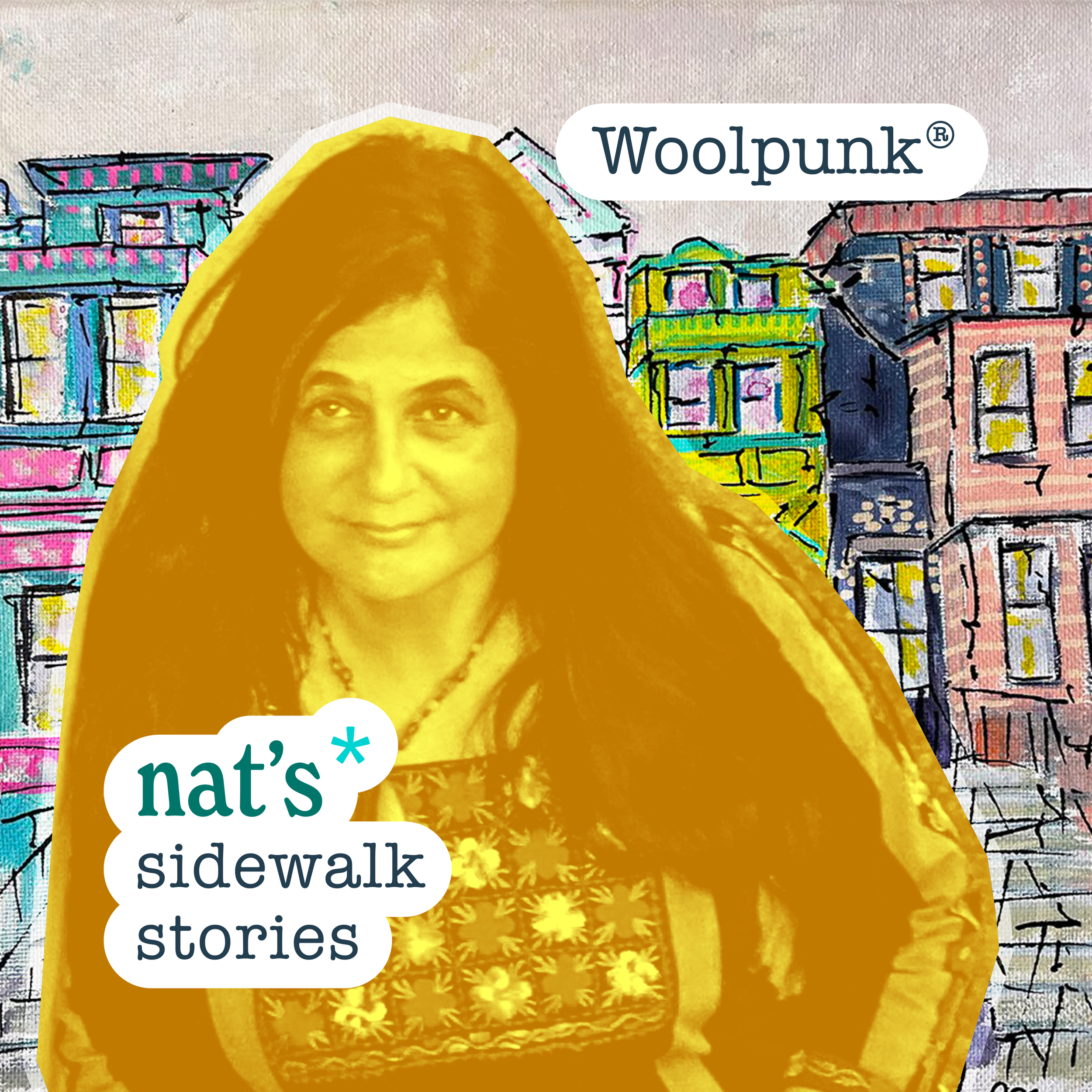
About This Episode
Woolpunk® is a fiber artist, activist, and educator who has called Jersey City home since 1995. She stitches into enlarged photographs of buildings, streetscapes, and sites of tragedy — turning wool and thread into acts of remembrance, protest, and love. In this conversation, we explore what it means to be punk with a needle, how Jersey City became her muse, and the cultural losses the city still hasn’t reckoned with.
Meet Woolpunk®
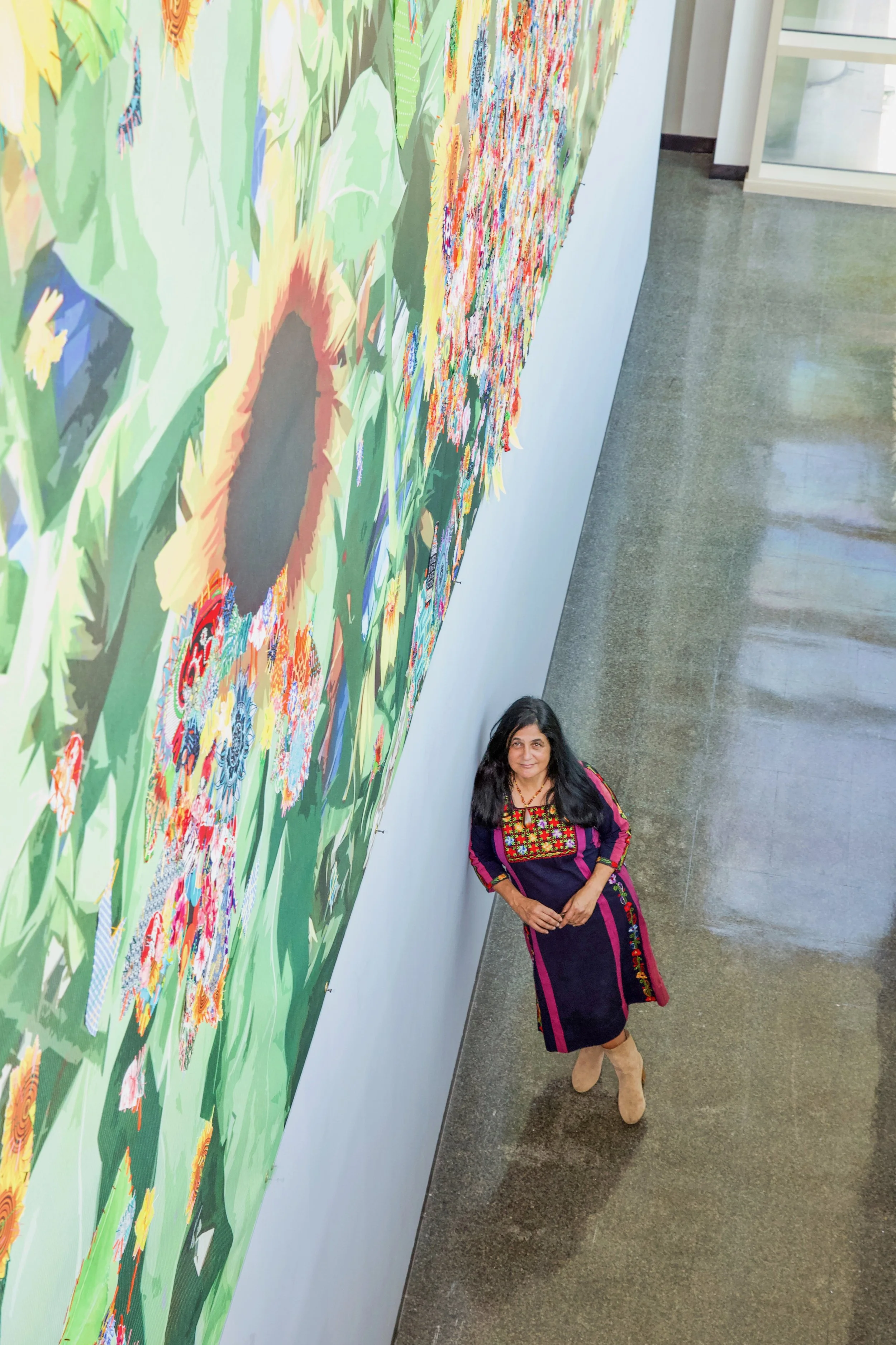
photo curtesy of the Woolpunk®
Woolpunk® is an American artist born in Summit, NJ in 1971. She employs materials and techniques sourcing women’s work creation — machine-knitting fiber installations, quilting sculptures, and embroidering photographs. Her work champions social change, addressing issues such as homelessness, foreclosures, water contamination, and deforestation. Referencing her unique stitching and use of fibers, she trademarked the name Woolpunk®, which she has been using creatively since 2004. She has called Jersey City home since 1995.
Connect with Woolpunk®
Key Insights
Stitching as inherited language: Woolpunk®’s practice traces directly to a great-aunt who studied lace-making in Rome and a grandmother who sewed American flags after arriving through Ellis Island. She describes the moment she lay under a lace tablecloth as a child as one of her earliest memories — and the origin of everything.
The name came from punk: Her trademarked name was coined by sound artist Matt Pass after watching her knit “like a sailor” at her solo show at the Jersey City Museum in 2005. Beauty was never the goal; the work is intentional, political, and intuitive.
Jersey City as muse: Moving here in 1995, Woolpunk® documented the city’s textures of disparity — luxury condos beside the Turnpike, the Pathmark as community crossroads, the slow drilling sound of development drowning out the quiet she once loved.
Making blankets so beautiful a passerby would want one: The Gimme Me Shelter project (2014), born from post-Hurricane Sandy work with the United Way, was rooted in the belief that people who feel unloved deserve something made with care. Everything was recycled fiber; the mission was love.
Mass Stitchings as prayer: After the 2019 Jersey City mass shooting — when her daughter called crying from school — Woolpunk® began creating large-scale textile memorials photographing sites of tragedy. She describes stitching as “a bit like praying.” She is currently working on a piece for Sandy Hook.
A flag facing Ellis Island: Woolpunk®’s massive knitted American flag was installed at the Central Railroad Terminal in Liberty State Park, directly facing the island where her grandmother once arrived.
Closing question — who from the past: She’d go back to the Jersey City Museum and give the staff a chance to speak about what they worked so hard to preserve, what succeeded, and what the city should build from. The museum’s first exhibition featured Jaune Quick-to-See Smith — an indigenous artist — in her first solo show.
Visual Documentation
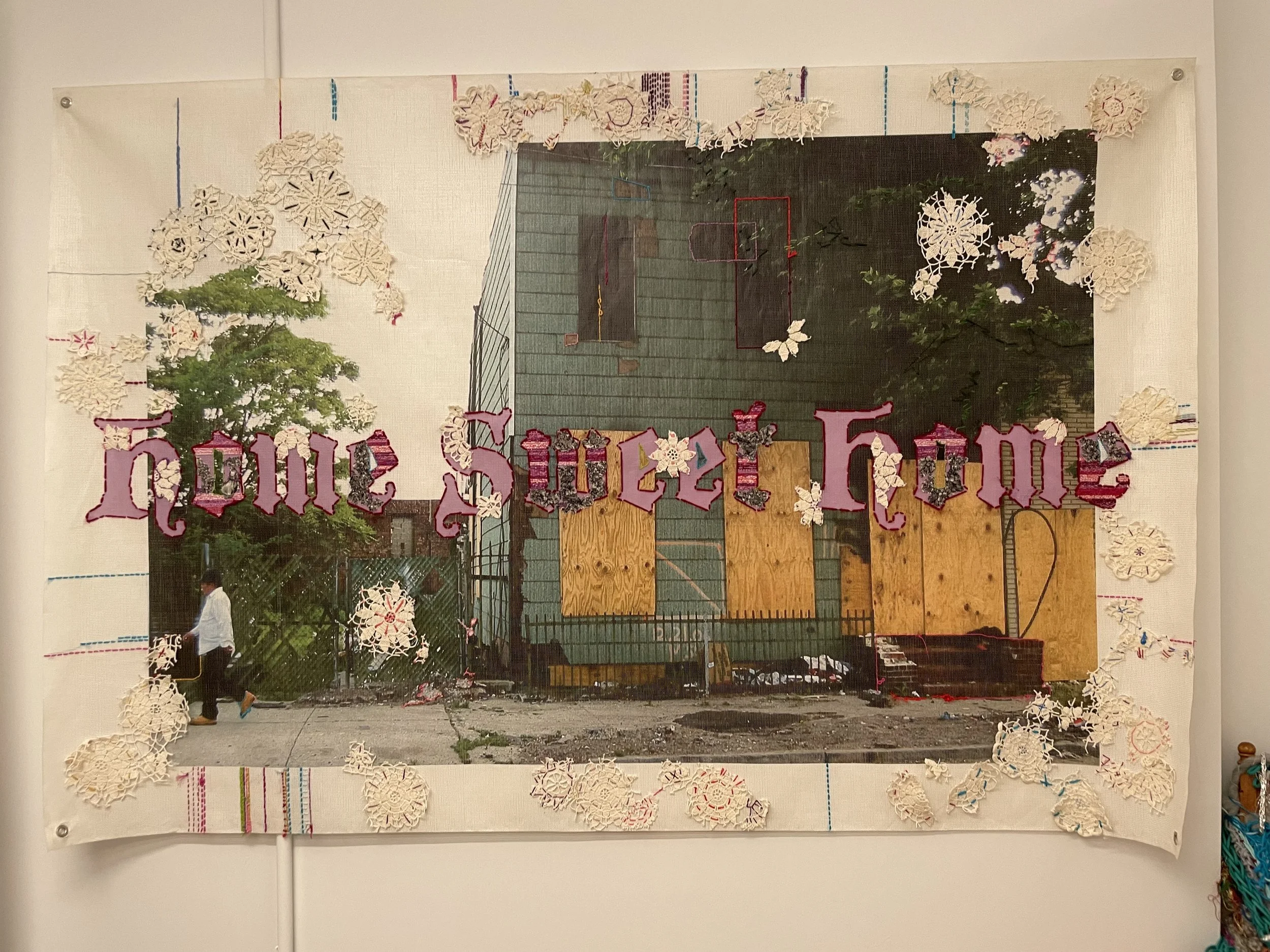
Home Sweet Home - the piece Nat made fall in love with Woolpunk’s work
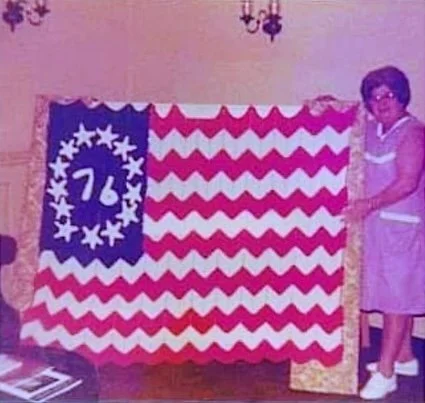
Grandma Josephine with the flag she knitted for the bicentennial parade in Madison, NJ - photo curtesy of the Woolpunk®
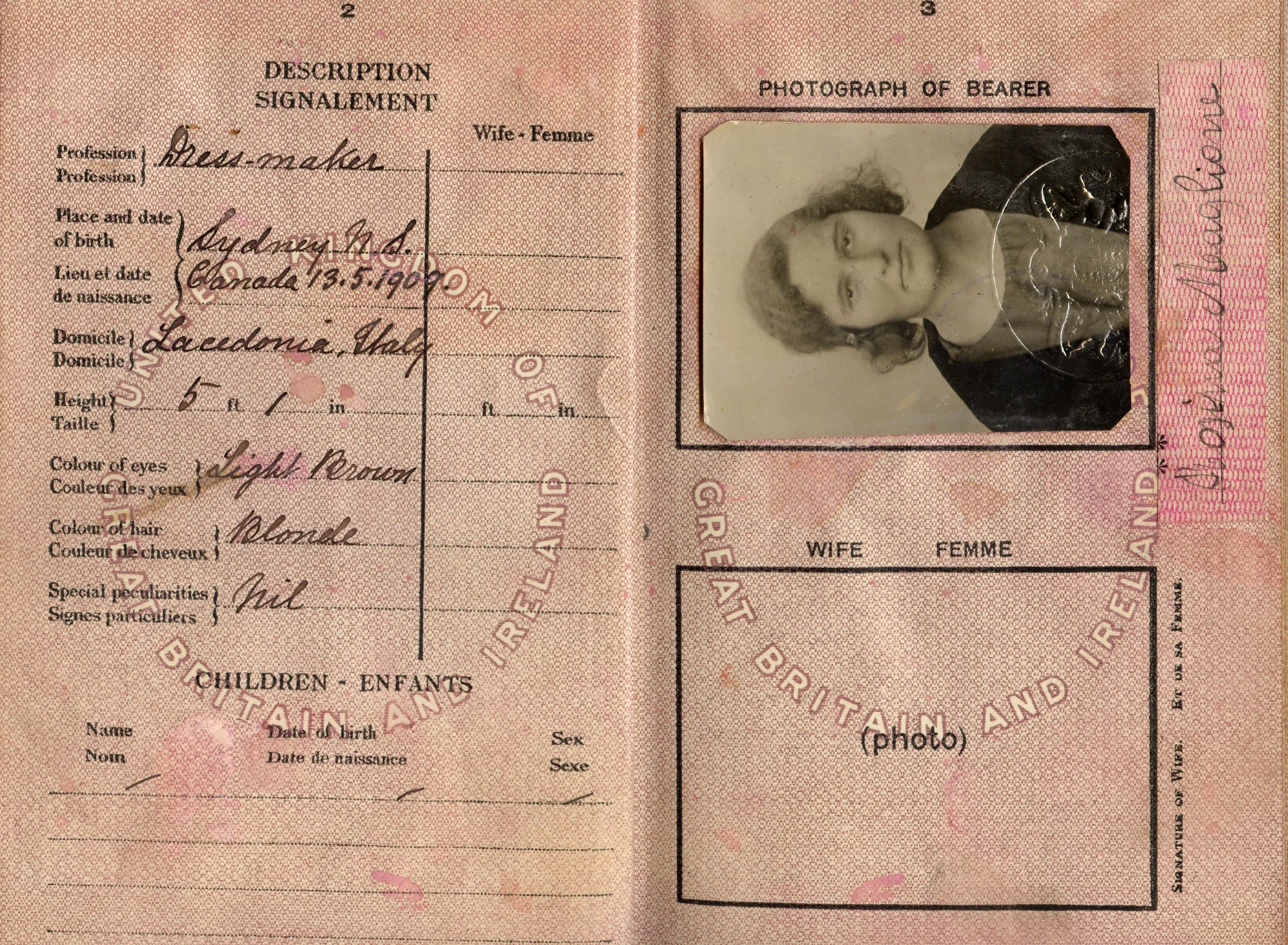
Grandma Rosina who sewed American flags for a living in Verona at Annin Flagmakers -photo curtesy of the Woolpunk®
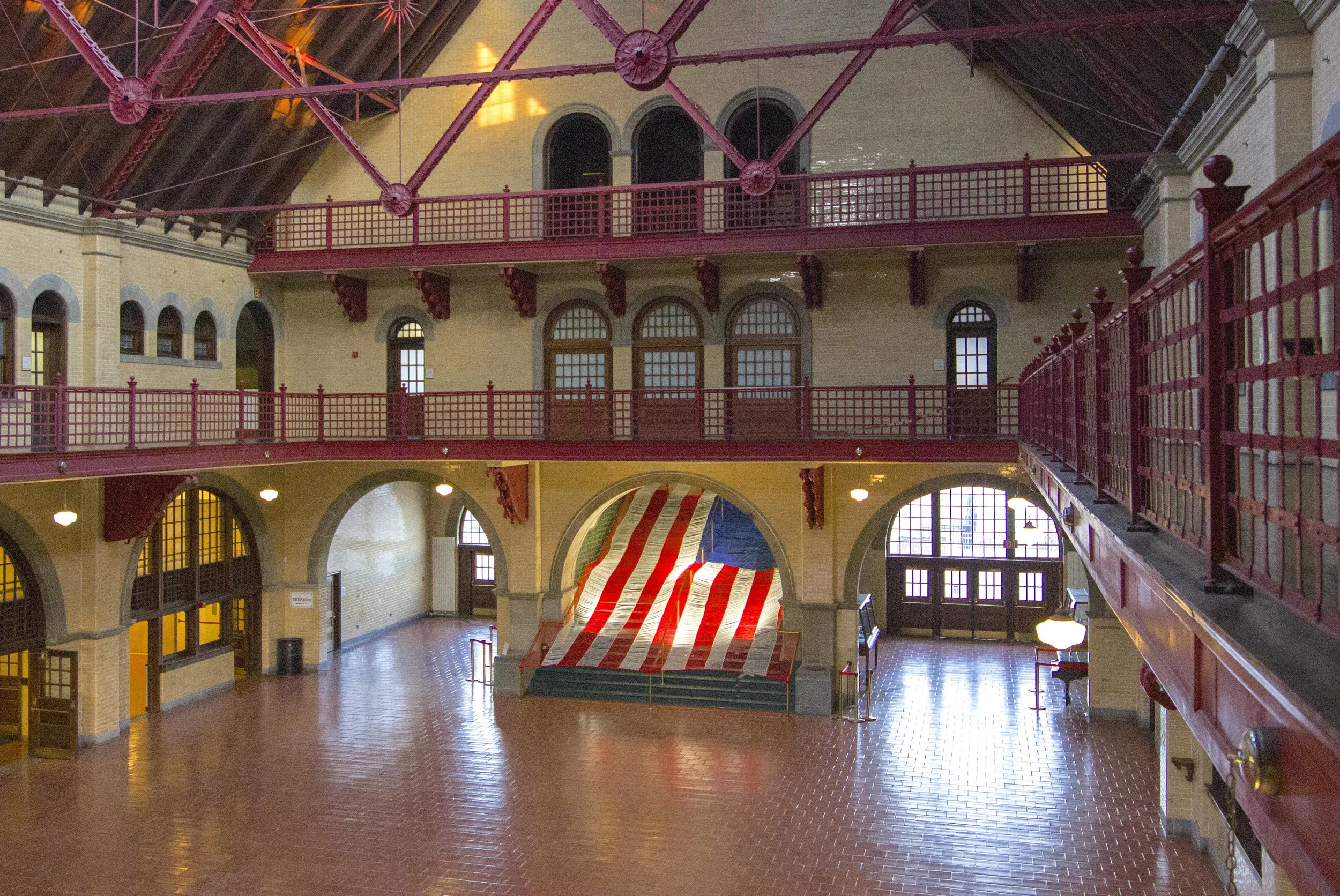
Woolpunk®’s flag at Liberty State Park - photo curtesy of the Woolpunk®
Places & Projects Mentioned
Liberty State Park / Central Railroad Terminal — site of the knitted American flag installation
150 Bay Street (JCAST) — where Nat first encountered Woolpunk’s piece “Home Sweet Home” in 2021
Jersey City Museum (now closed) — site of Woolpunk®’s 2005 solo show and years of teaching work
Centre Pompidou x - a planned cultural institution in Jersey City which is not moving forward
Ellis Island — where Woolpunk’s grandmother arrived as an immigrant
Padula, Italy — artist residency site where Woolpunk® stitched onto photographs of the town
Union Square, NYC — where the concept for Give Me Shelter first took shape
South Street Seaport (Karen Bravin Gallery) — where Woolpunk’s Bernard Goetz piece appeared on CBS News
Coming Up Next
Stay tuned for our next episode — more conversations with Jersey City’s makers, preservers, and storytellers.
Connect with Nat
Website: natkalbach.com
Email: podcast@natkalbach.com
Substack: https://natkalbach.substack.com/
Instagram: @natkalbach
Music: Our theme music is “How You Amaze Me,” composed by Jim Kalbach and performed by Jim Kalbach, Bryan Beninghove, Charlie Siegler, and Pat Van Dyke.
Support the Show: Subscribe to the podcast and sign up for Nat’s Substack to receive additional stories and visuals that complement each conversation.
Full Transcript
Nat Kalbach: Welcome to Nat's Sidewalk Stories. I'm Nat Kalbach. Today I am talking with Woolpunk. She's a fiber artist, activist, and educator who's been calling Jersey City Home since 1995. Her work is unlike anything you've seen. She stitches into these enlarged photographs. Um, they depict buildings, street scapes, and also sites of tragedy, and she turns wool and thread into acts of remembrance protest and love. I first encountered her piece called Home Sweet Home at JCAST, in her studio in 2021 at 150 Bay, and it really stopped me in my tracks. But what really drew me in wasn't just the art, although. That is a lot. It's amazing. It was also the story behind it. Woolpunk's, grandmothers, one who sued American flags after coming through Ellis Island and another who studied lace making in Rome. they both planted the seeds for a practice that stretches across generations. In this conversation, we talk about what it means to be punk with a needle, how Jersey City became her muse, and we talk about a cultural loss the city still hasn't reckoned with.
Let's go.
I'm so excited to be here with Woolpunk. How are you?
Woolpunk: I'm good. Thank you so much for inviting me. I was reading, a lot of your work and I, I love the people you've interviewed. I think they really,, showcase Jersey City well.
Nat Kalbach: That's amazing. I am so excited to have you. I wanna first ask you about your origin story, I know that you have talked about it in other interviews, you talked about your grandmother.
She came, through Ellis Island, and she's sewed American flag for a living. And, um, you also have a grand aunt who, studied lace making in Rome. did you grow up, um, learning this and how did you realize you want to use that in your artwork?
Woolpunk: So I just was writing something recently. Somebody had asked similar question for, a book and, um, I had this memory, I have this memory of like, I'm really young, like maybe I am like three or four. And we are putting the tablecloth that's all lace, on the table. And it was Zizzi Diletta's, tablecloth.
And she was, her and her sister studied in Rome, lace making. And I crawl underneath the table because I remember my grandmother going, don't touch it, because she could see me. And I like went under the table and I had this kind of like, it's like one of my earliest memories and I'm looking at everybody through the lace as they're walking and they're setting up Christmas and there's like a lot of excitement and you can feel it.
And I'm just like having this moment with the lace and I ran my fingers. I can still feel that moment. It was like this moment where I was like, this is something really super special. And even with my grandmother, when she threw it, you know, like she like fluffed it to be on the table the way it was placed, you know, lovingly placed.
I knew that this was something other than maybe cooking that my family, that women were good at in my family. And then when I went to Padula, uh, for an artist residency, I, stitched on a photograph of the town and the, the people of the town donated the textiles because we create like a circular economy that way.
And, the women came to my show and they ran their hands over the way that I ran my hands over my great aunts, tablecloth. And I felt like, yeah, that's it. Like, that's, it's just a legacy. It's, it's pride. It takes forever. You know, like so many of my little stitches, I think like, is anybody going to even really care?
And then I went to graduate school and I was, a painter. And Rutgers, at the time when I went, Martha Rosler was my thesis committee, Emma Amos, Tom Skalski, they really pushed me.
Emma Amos, I would say more than anyone. I had these little weird stitching things in the corner and they're like, what are you doing over there? And I'm like, I don't know. And my art was so tactile, like my painting like that, I feel like it was like, they could see it probably more than me. And I, it, that's where it merged in graduate school, 1999 at Rutgers.
And then at that point I felt like I almost had to do it, like I felt it was something inside me. It was something that was special about my life, my family. And it was a long time ago, like now fiber is really cool, but it wasn't
Nat Kalbach: I love how you described this moment of, looking through the lace it's almost like a photography. You froze that moment in time and then now you have this connection of doing this on top of a photo. I think that's so cool.
Woolpunk: Yeah. I mean, I will add too that my grandmothers both passed around the time when I, like 2007 when I really was in it, and I felt like it also gave me a chance to kind of like keep talking to them.
Nat Kalbach: The name Woolpunk, which is trademarked, didn't come from a branding session. It came from a friend who watched Woolpunk knit or more accurately, watched her curse her way through knitting and said, you're not a knitter, you're punk. You are Woolpunk. So I asked her about it.
Woolpunk: I grew up, uh, listening to all kinds of music. Like, I also have a very peaceful side. I like the Grateful Dead. I like, rage Against the Machine, the Clash, I love it loud and hard. my friend named me Woolpunk, Matt Pass, he was a sound artist, and I had a solo show at the Jersey City Museum, like in 2005 or something, and we were walking over and he's like, you're really like not a knitter. And I'm like, yeah, no. And like, and I'm not, like, my grandmother would always be like, you dropped a stitch again.
And my kids used to joke and my family used to joke that I have like knitting Tourettes. I knit like a sailor. Like it's not a peaceful, it's not that peaceful. Like I watch women, I'm so jealous that they can sit there and lovingly like, that is not my experience. I knit on a machine and I'm still cursing like a sailor.
And so he says, he goes, you know, he is like, you really not like a knitter. I'm like, I know he is like, you're like punk. You're like Woolpunk. And I was like, I am totally gonna take that. Like, I, I actually said that out loud. I'm like, I am totally gonna take that.
I love that. And I think that's kind of guided my mission. I always am amazed when people say some of the work is beautiful because it's really like, not the goal, like the goal. Like I am never like, oh, this'll be really pretty if I like even do this. The goal is just more intuitive and basically I find all recycled materials usually.
I'm rarely going out and buying things. People donate to my studio. Like I get a lot of people sending me scraps and things. But I like that because it's like the culture, like you know, things that I would never get my hands or, or ever even think. And then I love that people think like, that's beautiful, right?
Nat Kalbach: Woolpunk has lived in Jersey City for over 30 years, and when she talks about the city, I mean, you can really hear both the love and the grief. And she told me recently, a curator said something that clearly hit a nerve.
Woolpunk: I kind of grew up in Jersey City as an artist, and the piece that you're referring to, was the pathmark around the bend for my house, I think in 2001. And, the original title was Purple Trees Behind the Pathmark. Because it was such a meeting place for so many people, it serviced so many neighborhoods.
And, in a way, one day I found myself back there and even though the turnpike was just above my head, and you could see in New York, it felt like. I've had so many feelings about how people were living and just around the corner they were selling even then these beautiful mansion kind of Van Vorst. Park things for a lot of money and it was just such a disparity at the time.
So, uh, Jersey City became my muse for many years.
Nat Kalbach: what made you move to Jersey City and what has changed, because you've been here for over 30 years, so it must have been a ton of changes.
Woolpunk: So in that time period, I did leave, I just wanna be honest, for like a year and a half, we moved to Delaware because I, I had my daughter and I just wanted to stay home. So we lived in my, ex mother-in-law's beach house. But, I moved to Jersey City because I liked the access to New York.
Um, in college, my friend and I dressed up as roller derby girls, and we were the Jersey City wheelers. So I always feel like that was like, and that was only in like 1993 or something. So I feel like that was like my premonition and then. At the time Jersey City was starting to kind of come back a little bit, like along the waterfront.
They were starting to develop some housing. We used to get chased by dogs regularly. There was like all these, I lived in Paula's Hook and, but I loved it and I still love it. I wish that as a city we would have honored maybe a little bit, of course, a lot more of the, uh, the cultures that were here and the people that were here.
I still think though, despite how much change has happened, we have kept some authenticity. And I always, I love that like when you go into, when you go into restaurants. Maybe not now so much, but there was a time period from about 2000 to maybe 2012, 15, where you go into restaurants and you, it was authentic cooking,
Nat Kalbach: Yeah.
Woolpunk: And you know, like there's still some places like Saigon Cafe, on, uh, Newark Avenue that's like, that's grandma on the back kitchen, there's a lot. And I think too, it's a kind of place that , makes you feel needed a bit, but also there's a lot of people who are ready to help. That's kind of how I feel like Jersey City is like, it's a little bit of like, oh, I, I have to go down and help Liberty State Park because they're having trouble with like, you know what I mean? But I never think, oh, I'm on my own doing that. There's gonna be a of people with you with the same, our politics are, uh, you know, pretty great.
I think in some cases, and I think maybe because many years before that the politics weren't great and people were like, we need to change here. I still think the arts in Jersey City has a long way to go,
I think we have a ton of great artists here, but I just mean organizing and coming up with like a common good for everybody that works.
Nat Kalbach: You said that Jersey City is your, it has become your muse. So, um. When you are walking, or I assume you're walking, you may be driving, I don't know. But if you're like roaming through Jersey City in whatever way of transportation, how do you know when you found your next subject?
What makes a place call out to you and says, Hey, you want to stitch on this?
Woolpunk: Well, that's kind of changing. Like actually a curator said to me recently, you're losing your, I think she said muse. She's like, you're losing your muse. And I was like, yeah, no. Um, Jersey City used to be like the Grand Canyon, but like the opposite, like where you go to the Grand Canyon matter where you put your camera, you could always find some gorgeous shot.
Jersey City is very much the same, but the opposite, like aesthetic. I had a piece at the Montclair Art Museum. It's called Blue Carts and Barbed Wire, and. People thought that I photoshopped the landscape, that it couldn't have been in that much disarray. And I'm like, no. That was just like around the corner.
There was, it was like a fence that was pulled out and I quilted the fence and inside the fencing, which it stayed like that for years. I mean, that land was like that from like about 2004 until like, I wanna say 2010, like at least six years with these blue carts. They might've been used for the path train maybe, I'm not sure.
And they were like a cobalt blue. They were really pretty. It was like a, like a, a lawsuit waiting to happen. Like anybody could have crawled through, any child could have crawled through there. And I think that was my frustration, even though it turned into a beautiful photograph, was that like, you know, why were land owners allowed to treat our city and our citizens like that. And that was a problem for a long time. We had a lot of empty storefronts, even in the heights, like for years, it was like one or two, I heard it was like one or two people or a few people who would not take care of their storefronts, not rent them, they would sit.
And then that really, you know, jeopardizes the quality of life in a neighborhood and, um, makes people feel like bad about where they live. And considering that we can see New York City in most places where you're walking through Jersey City, that seems kind of silly, right?
I'm gonna be honest, I loved Old Jersey City. I loved it. Like, I don't know how much longer I'm gonna be here, but like my daughters grew up here, chain fences with blue carts. I still loved it. I loved the people. I love the authenticity. I love the space. I love the quiet moments that you could have being so close to New York City, but still being right.
And I, I think not only has it increased with buildings, like look at Journal Square, my goodness. Um, it's increased in noise. Like it used to be quiet in Journal Square, like when I would walk around and stuff and it's, there was a time where there was just like, you, it is just drilling, drilling, drilling.
Like I think maybe it's quiet, not 'cause it's winter, but. I step outside it is the first thing I hear and it's coming from all directions. And a lot of places have recently got up, but like last year, you just felt like the ground shake all the time.
Nat Kalbach: What really draws me into Woolpunk's work is that no matter how political or painful the subject, The act itself of her making the art, the stitching, is always an act of love. She told me about a couple projects that show exactly what I mean.
You did the Give Me Shelter project in 2014, which came out of your work with the United Way after Hurricane Sandy. Right. And so, um, it was when Homelessness Rose about 16% statewide, which was already high. And you said that you wanted to make blankets quote so beautiful that a Passerby would actually want it.
Can you talk a little bit about what this intersection of, aesthetics and utility, like why beauty for you matters even when you're addressing something like a crisis?
Woolpunk: Thought about That's so like, wow, you're smart. Originally that was going to be, I was in, um, union Square and I was reading, um, Henry Miller Tropic of Cancer, and I was sitting next to the meth. There's a meth clinic right around there, and it was like real life was happening and I just felt like there was like such a community, even if it was a community that like I wouldn't partake in, you know what I mean? Of like needing each other and like understanding like the, like it was like a ride or die group of people, you know, who were really there for each other, even though their issues may not have been, common issues or my issues or, you know, and I respected that and I put the book down and I started listening to them talk more than reading the book, you know?
And, then Hurricane Sandy happened and, um, I, I had already had the idea in my head that I wanted to like, love people like, who maybe don't feel. Like that they're loved or something, I felt like that was a part of it. And I felt that's why I really wanted to make the blankets beautiful because, or maybe beautiful, but not even in a traditional sense.
Like I just wanted to have something where that somebody knew that, that someone cared,
Nat Kalbach: Yeah, I love
Woolpunk: even if it was in the simplest way. And that was the only thing, I'm actually like decent. And so I was like, and everything's recycled. Like I would get the fibers and I would recycle them. I rip apart sweaters to stitch and try and, make that all positive as well for the environment.
And I just think at the end of the day, to be quite honest, I'm just trying to like, and this may sound corny, but even when I'm on like a rant or I'm saying something that may be hard for people to hear or see or think, or accept responsibility for, it's outta like love. I think it's out of love for like either in the Trump hats, like either like.
A love for the people that they're hurt, that feel hurt by their views, or if it's in mass stitchings, I'm trying to honor the victims, and honor the people who lost their lives. And I'm also very sorry that this is going on and that we haven't gotten it together, that like we have to have children going to school regularly in fear.
It's very chaotic, you know? And so, and in that case, I feel like I'm loving.
Nat Kalbach: And also there is an hopeful component with it, right?
Woolpunk: Be hopeful.
Nat Kalbach: right?
Woolpunk: I mean, I, I, I do think it is like, there's like also a fixing, right? Like we're trying, like it's out of my control, but I'm trying to like, I think doing the mass stitchings, so the mass stitching started and you live in that area because in 2019, Jersey City had a mass shooting, right? I dunno if you remember this, there was a Jewish daycare.
Nat Kalbach: Yeah.
Woolpunk: So that's how it started. My daughter was at school, she called me crying. I could hear all of the kids crying, crying to their mom, scream. Some of them like screaming, mom. It was, I can talk about the other mass stitchings without getting upset. But this mass stitchings always makes me really upset.
The first one, she wasn't even in the area. She was blocks away. She went to a school on Kennedy Boulevard and it was more where you were located, but she was close enough that they had to go into lockdown, that they were scared that they knew something was happening, that they were away from their parents.
And it was more of like our reaction to that. Like I remember I drove out. And there was a for rent sign, there was like a big couch in front of it. Like nothing had happened, you know, and there was like, I think police officer died there two people who were trying to, and maybe the deli owner.
And when I was like, Jesus, and we're not gonna do anything about it, are we? Not Jersey City. I mean, this is like a nationwide thing. I had no control over that. And it was really hard to, I can't even imagine what it's like for parents when there's actually a school shooting at the school.
Because that was one of the hardest things I've ever, like, just shock and sad and like, oh my God, what is going on? And I hadn't heard, my daughter told me. I think like I, a lot of times like homelessness, I'm not gonna fix it, right? I'm one person, but I will tell you, the community never lets me down.
Like ever. They come, I mean, for Liberty State Park, it was a 10 year anniversary and we had something like 400 people or something like that. And people were going to the ferry just on their day. Like we had a whole group from, I wanna say like Germany or somewhere, I can't remember.
And in between the time their ferry was about to go, they came in and they sorted in the back room. And all of a sudden we had 50 people sorting. They were like, for the homeless, of course, and like even the first time it was like that too. I was making these blankets and somebody told me to reach out to Jersey City hag, which was the homeless advocacy group.
I reached out to them, they were lovely. It was like, Gina Verdibello and Esther, they were running this group and they were like, you can't make all the blankets. And I'm still in the mode that I'm gonna make 60 blankets.
And they're like, well, you know, could we do it with you? We wanna help. And I was like, all right, let's have like a stitch in. And that's how it started. The first one was in Jersey City, city Hall and next thing I knew nj.com did something and the news channel came out and then Charlotte went to school, my youngest, and she was like, mommy, all my friends saw me on news and it just kind of hit it.
It got so popular that a radio station DJ from this state radio station, like it was a religious radio station in southern jersey, maybe 99.1 or seven or something. They're advertising my stitching, but like they're getting the wrong date. And I call them and I'm like, thank you. You gotta say the right date because people are like, I'm one person.
And so they, so the manager gets on and he's like, did you pay for these advertisements? Oh, well, I'm like, I don't even know who, how you found out. I'm like, somebody's just trying to do the right thing, trying to advertise these things. And it got to the point where no joke, like I was sleeping in a double bed and I didn't have a studio.
So I was stacking the blankets in the donations up against the second side of my. Bed and I was sleeping with them. I had them in my car. It was like a drug like, like switch or something. I, they're like, okay, my grandma, she knitted you a blanket. It's on Route 10. Can you come pick it up?
That's part of the reason why I can't do them all the time 'cause I don't have the space. And that's the part that I love. Mass Stitchings. I feel the same. Like when I say I'm gonna do a mass stitching, I always think are they gonna let me show this?
And every single time people are like, they, like one went to Manna, when I do a piece, I like to either get donated in the area or exhibited in the area somewhere where it kind of floats in and outta the culture . And like even in Karen Bravin last year or two years ago at, south Street Seaport, she had that huge fiber show that I was in.
And I was like, could I show the one that I did for Bernard Goetz? And she was like, yes, I love that. Like, I'm never sure. And then that ended up on CBS news and then people don't let me down. I don't think it's because I'm making like Monets, I just think it's because people feel it too. Like a lot of my work, like Mass Stitchings I go and I photograph the site and I don't go to church regularly, but I do feel like I'm praying a bit when I'm stitching in and I'm remembering, I try and make one once a year, of those pieces because it's my way to like bring attention and contribute to society.
And, but then when I start reading the stories of people, right now I'm doing, uh, m stitching Sandy Hook.
Nat Kalbach: Yeah.
Woolpunk: Oh, it's rough. Like it's, it's a lot like you. I try and read about the, just to be respectful of who was involved and what exactly happened. And Sandy Hook was a school shooting. It was like one of the first, like, it was children.
Columbine was the first, but, you know, or one of the big ones, uh, this one was a rough one. And I just feel that it, it connects me, um, not even on like a physical level, like it could, trying to say is it connects me on even like a mental, spiritual level to what I'm thinking about,
Nat Kalbach: one of Woolpunk's recent, but for me, most striking installations was a massive knitted American flag, which was draped over the staircase, at the Central Railroad terminal here in Liberty State Park. facing Ellis Island And that's where her grandmother once arrived. So to understand how long it took to make, she measured it in game of Throne seasons.
So you did this amazing flag installation at the, central Railroad Terminal facing Ellis Island.
Can you tell us a little bit about it? I also wanna know if that meant also personally something else for you because your, grandmother used to do flags and, and came through Ellis Island.
Woolpunk: Yeah. I don't think I would've laid on my back for like two. I mean, I like, I installed it in a rush for Art Fair 14 C 'cause it like we had to and that took, first of all, just to knit it. Do you watch Game of Thrones? Okay, so full season. One time Game of Thrones full season, like one through eight, second time Game of Thrones and then all the way up to like five or six.
And then I watched five or six again just 'cause I like those two. So that's how long it took me to knit that thing. And then I finally get to Liberty State Park. And Liberty State Park was great. They were great about all of it. They gave me a back room, I hand stitched it all together, just underscore like underneath.
And then when we came to install, it was tricky because those stairs, they go up and over, up and over, there's like, it's like it's not a straight shot up and down. And I was about an inch off on each stripe that I made. And there were 17. How many stripes are there? Right? So like at the end I was about six inches.
So we had this ray from Liberty State Park. Oh my God. I really love Ray because that was how it, it kind of got up and um, and then they were like, Hey, we wanna keep it up. And, and oh, and I will say in the first. Showing of it. I worked with Jeremiah Teipen who I worked with at HCC, and he created that video.
He was mastermind and under all that, I dunno if you saw that, but there was a video that went underneath it and then shined through it was cool because he not only did stars, he did like outer space and he also did like water. He made that whole film and then he shot it up, through the flag.
And that was always the plan. And then when they wanted to stick around, I, they were like, but they were worried about, I had to like release it to them. So, and I was like, I'm fine with that. But then I had to restitch it I had to fix every line.
And so for two months I laid on my back and I fixed that thing, to be like couture and, uh, yeah. But it, I think really it was a shout out to my grandma also and my other grandmother. There's one picture that I have on my Instagram of my mother and I holding a 1976 flag that my grandmother made with like zigzags and it's just like a blanket.
And my grandmother, I didn't realize how cool my grandmothers were. My other grandmother, not the one who sewed American Flags, she knitted that for the Madison Parade, the bicentennial parade. And she had a whole float. And I grew up thinking that like. This is what women do. They make beautiful lights on tables and they make these, they knit flags for, for parades.
And she was like a little bit of a celeb for that. Like she got some serious street cred. And so my mother and I went to my flag and we held the flag of my grandmother's. 'cause we still have it. I have it in my house. Like it stays with me now. It's mine. I, I've taken it and nobody can have it. And it was kind of like a tribute to both of them in a lot of ways and how much they affected my life in so many positive and good ways, you know?
And I think that's why I used, ooh. And I don't think I'm the only one. I think a lot of artists do who, especially who knit and stitch. That's why I use love as the message basically. Or even when I'm not saying like super nice things about certain people, because I feel like that's how I learned it. We didn't have a ton of money growing up. Like it was the seventies. I don't think anybody really was like, super, you know, it wasn't like today.
Nat Kalbach: Right.
Woolpunk: um, my mom and I made my communion dress and I remember asking if I could have like a popped Princess Leia collar. Like, I was like, could we pop this?
And my mom's and my mom's really good at sewing. And she was like, yeah. And then I almost I had like a Battlestar Galactica like crown and a veil. But I was totally going sci-fi with that. Like it was a whole sci-fi like in my head,
The reason why I'm sharing this is I just think that's such a, showing of love and affection, especially when it's generational.
Um, and you know, and I think that's why it's easy for that to continue in the work right basis of knitting is, getting a blanket or socks knit socks from your grandma or whatever the case be. It's, it's an art of love really.
Nat Kalbach: Yeah. That's so beautiful. I love that. I'm gonna ask you my, uh, signature question, which is my last question I always ask everyone, and that is, if you could spend an afternoon with anyone from Jersey City's past, who would it be? Which corner would you choose as your meeting spot and what one question would you ask them?
Woolpunk: This is so good. Okay. So, so can they be alive but they just don't live here anymore? Or do they
Nat Kalbach: You can be as punky as you want on that one. Yeah.
Woolpunk: Um, I would really love to go back in time when the Jersey City Museum was here and, maybe give a chance for the staff to talk about, why that. All went down and what they did, what many people did behind the scenes that a lot of people don't realize, , that, um, and a lot of people work to try and keep that open.
And now with the closing of the Pompidou, we're kind of find ourself, again, closing a cultural institution. And I can understand everybody's point. I'm not saying that people don't have valid reasons why or why not to support it. I'm, I'm not really saying that, but I just think when you're living in a place, and I've watched two places, the Jersey City Museum broke my heart.
And it broke my heart because I was, uh, a teaching artist there and I was a Jersey City Public School teacher there, and I was a young artist there. I moved here because that was opening up. I bought my house so it could, I could be two blocks away. And I feel like, you know, personally, like I had gone on and off unemployment while I was there to try and keep it open and I just, I just think we really need to, as like a society as like a sophisticated like cultural society to kind of.
Try and make something work here like we should. I think at one point we had the 12th largest downtown. Now we probably even surpassed that in the United States, and we can't make a cultural institution. I'm not saying that other people aren't like that. Smaller cultural institutions aren't as important, but I mean like one that like has, a whole, like a whole education department, right?
And I'm not saying that the other places aren't valid. Every, everybody's contribution big or small is totally valid. But, you know, it's, I would try and ask the people who work there, including like myself, I, I worked there when it closed. What happened?
What did you do? Why? You know why? Because I get asked that now and I don't. You know, wanna take your show away to talk about this part, but like, you know, sometimes when people realize, oh, you were the director of education when that was closing, what was that like? It was a nightmare. It was an absolute nightmare.
Um, it was depressing. Um, we lost our collection, you know, and it's like we have to kind of stop and think sometimes, like, you know, there, it's not just, it's not though. The artists are super important. Jersey City, I love many of them. It's not just about the artists, it's about families. It's about education, it's about cultural value.
Um, it's about retaining a collection that reflects the community.
And I know there were all these different reasons why everybody made a valid point, but we as a, as a group, as a community have to kind of come together and come up with some kind of decision of how we can co create a collective identity that has a history to it.
Beyond just things that are like from the 19 hundreds, we lost all of that, right? So I would say I really would love to, go back to that first institution, you know, so maybe that could have helped inform the second situation that we just had where we lost another cultural institution, that, would've provided opportunities and internships and, um, jobs. And, uh, it would've maybe helped a lot of, I know I was looking forward to it because it would've helped a lot of the cultural institutions in the area in
Nat Kalbach: Mm-hmm.
Woolpunk: You know, many times everybody just thinks the art scene is downtown, but it's not. There's a lot of great spaces, but, and it can be all over, I don't have a solution. I don't have an answer, but I just think having like a, a sit down. With the people who were there and be like, what was your goal?
Like what would you change? Or what were you proud of? What are some things that worked?
Build something from that, you know what I mean? Like that history doesn't have to be so horrible. It could be something that we learned from, right?
It happened twice, right?
Was to show underrepresented, artists. It gave its first exhibition was to, Quick-to-See Smith. She was an indigenous and her first solo show was at the Jersey City Museum.
Nat Kalbach: wow.
Woolpunk: Yeah, so, and the students, I remember one time I had a class in there and they were like, this is our museum. This is like our museum. And I would even felt so proud for them, you know? And I was really hoping like no matter what shaped this time, that it was something where people could be like, yeah, this is our museum.
We just gotta kind of get there.
No matter what. It's branded as, get to a place that's collecting all these great things. You know, we need a collection.
Nat Kalbach: This was amazing for, um, this conversation. Thanks for coming.
Woolpunk: Thank you for having me. And I, you know, love it. I love all that you're doing. Thank you.
Nat Kalbach: Wow, that was amazing. This was Woolpunk. What a great interview. An artist who stitches love into photographs of the places and moments that matter most. Even when, well, especially when they are painful. I link to her Instagram. I really hope you follow her and to her website in the show notes along with photos of some of the pieces we talked about today. Including that incredible flag at Liberty State Park. And there might be also a photo of the flag that her grandmother made. It's amazing. Thank you for listening to Nats Sidewalk Stories. I'm your host, Nat Kalbach, And our theme music is How You Amaze Me. Composed by Jim Kalbach and performed by Jim Kalbach, Bryan Benninghove. Charlie Siegler and Pat Van Dyke. You can find show notes and more at natkalbach.com . Until next time. Keep looking at the places you pass every day. There are stories in the stitches.
