
Episode #322: The Spark in the Room with Lucy Rovetto
About This Episode
Lucy Rovetto has spent her life making art that makes you stop — and that's exactly what she asks for. In this conversation, Lucy and Nat talk about growing up in Greenville, working as an assistant to a sculptor in South Africa, nearly walking away from art entirely, and then winning a lottery for an artist live/workspace. They also get into what it means to curate — not just artworks, but the spark between them.
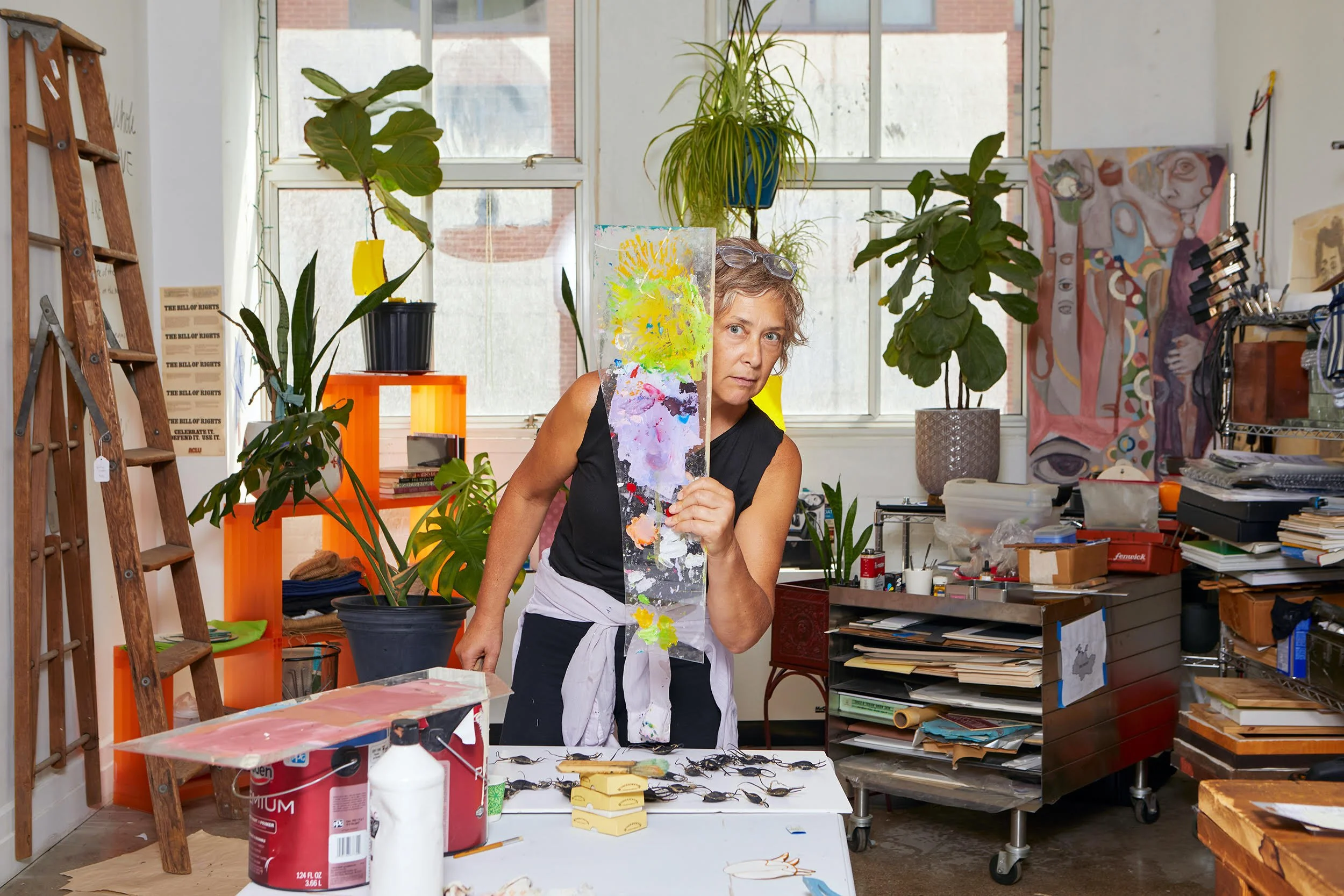
Lucy Rovetto - photo by photographer Megan Maloy
Meet Lucy Rovetto
Lucy Rovetto is a Jersey City-based painter, printmaker, and curator whose work asks hard questions about power, fear, and the structures we don't let ourselves question. Raised in Greenville, she spent years traveling and working internationally before returning to Jersey City, where she won a city artist live/workspace lottery and never looked back. She's curated exhibitions at JCTCI and the Museum of Jersey City History, and her studio is open by appointment.
Connect with Lucy:
Website: www.lucyrovetto.com
Instagram: @lucyrovetto
Key Insights
On neighborhood: The Greenville she grew up in was defined by people knowing each other across differences — Italian, Polish, Cuban families all on Danforth Avenue
On drawing as listening: Lucy discovered early that sketching wasn't distraction — it was how she processed and paid attention, from church pews to classroom desks
On the South Africa years: Working as an artist's assistant taught her the discipline of a prepared studio — something she didn't appreciate until years later in her own practice
On power and fear in her art: The questions she couldn't ask as a child in a religious household became the questions she's been making work about ever since
On curating: Half of what happens in a room isn't the curator's doing — it's the spark between the pieces and the people, the dialogue that goes "beyond choices"
On the Jersey City art scene: The most exciting moments have always been the raw ones — painting cars on Grove Street, experimental performances in buildings you weren't sure were safe
Visual Documentation
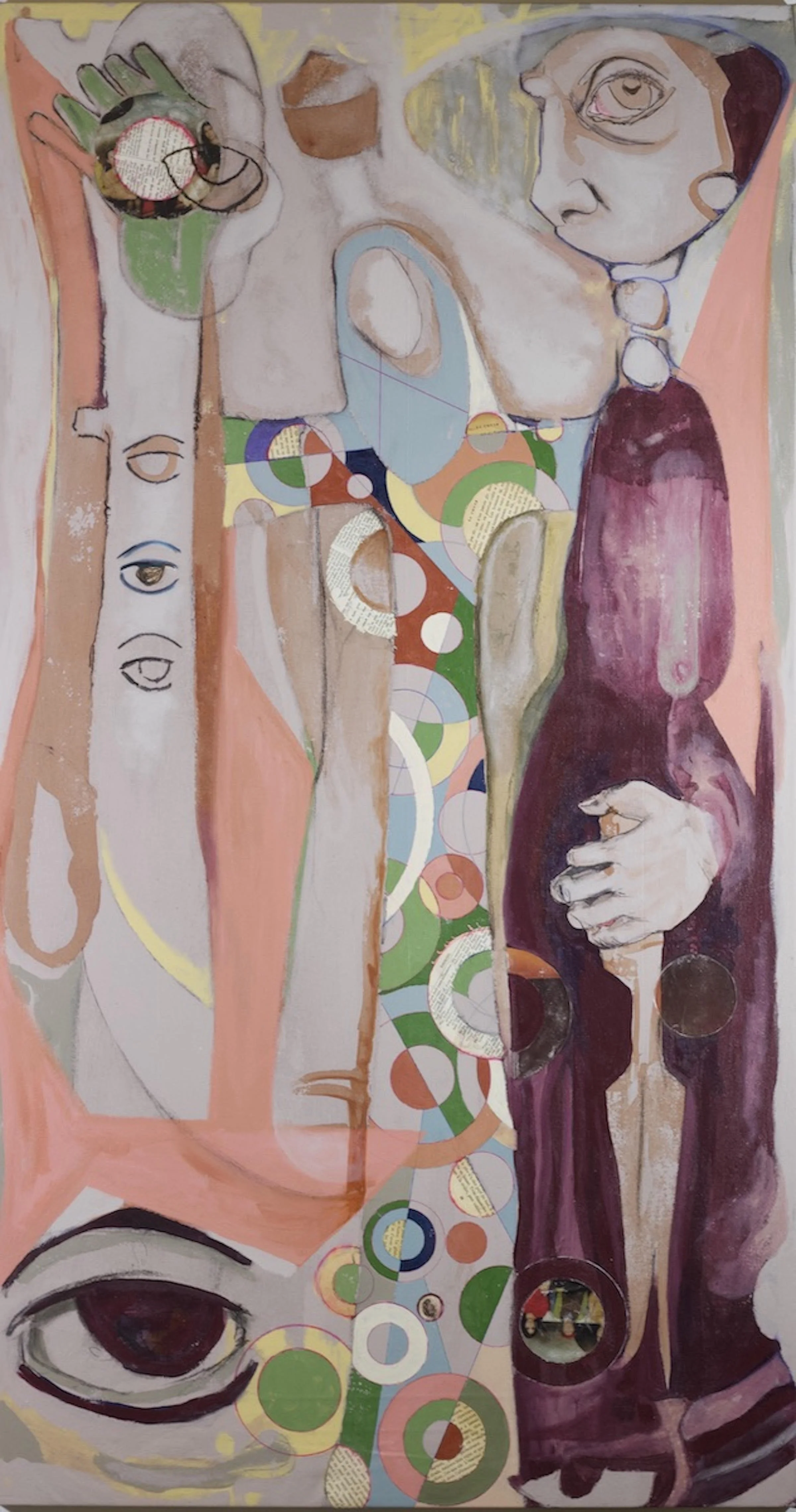
Ecco, Lucy Rovetto - Acrylic paint, collage, ink, charcoal on muslin, 54x29 in., April 2022 - photo courtesy of the artist
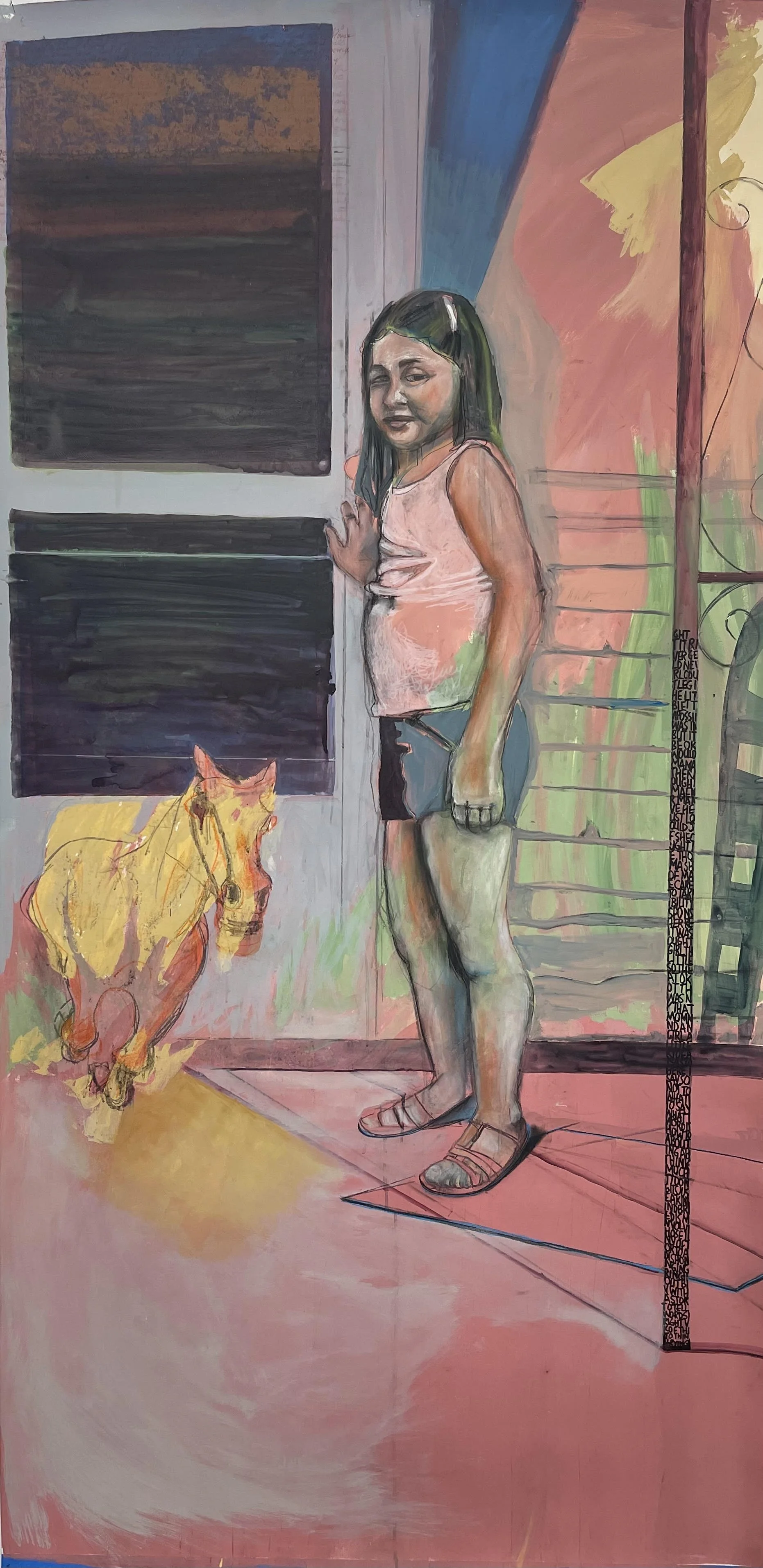
Family Portrait 1 of 3 (Pink Monsters), Lucy Rovetto, Vine charcoal, conte crayon collage, marker, acrylic on drawing paper, 84 x 42 in., Sept 2025 - photo courtesy by the artist
Related Resources
Coming Up Next
Stay tuned for more conversations with Jersey City artists, community builders, and the people shaping our cultural landscape.
Connect with Nat
Website: natkalbach.com
Substack: https://natkalbach.substack.com/
Instagram: @natkalbach
Email: podcast@natkalbach.com
Music: Our theme music is "How You Amaze Me," composed by Jim Kalbach and performed by Jim Kalbach, Bryan Beninghove, Charlie Siegler, and Pat Van Dyke.
Support the Show: Subscribe to the podcast and sign up for my Substack to receive additional stories and visuals that complement each conversation.
Share Your Story: What sidewalk stories have you discovered in your neighborhood? Share them with me through email or social media.
Nat's Sidewalk Stories explores the intersection of place, community, and storytelling through conversations with practitioners, community leaders, and local changemakers.
Full Transcript
Lucy Rovetto: [00:00:00] You put those pieces, you put those people in a room together and there's gonna be dialogue. And that dialogue that's created to me, it goes beyond what I did. It goes beyond my choices. It's something that's just next level.
Nat Kalbach: That voice belongs to Lucy Rovetto. She's a curator, painter, and printmaker. and she's also one of the few people that I've met who makes you feel like the conversation you're having is the most important one she'll have all day. I've known Lucy for a few years now. She curated my first solo show at the Museum of Jersey City History, and that wasn't really easy because.
Let me tell you, the [00:01:00] wallpaper and the floor all have a lot of pattern and my art is pretty bold. but she was patient with me in a way that only someone who truly loves art can be. In this conversation. We talk about growing up in Greenville, Spending years traveling the world on restaurant money, And nearly walking away from the art world entirely and then winning a lottery for an artist's life workspace. We talk about her art, which asks really hard questions about power and fear, and we talk about what it means to put the right people in a room together and wait for the spark. i'm Nat Kalbach. This is Nats Sidewalk Stories.
So excited to be here with Lucy Rovetto i'm so glad to have you, Lucy.
Lucy Rovetto: Thank you, Nat.
Nat Kalbach: You grew up in Greenville, what was it like growing up in Greenville and what do you remember [00:02:00] about that neighborhood? What's dear to you, that you remember mostly, as a kid?
Lucy Rovetto: Well, the most important thing is that it was a neighborhood. I mean, we went to school down the block. We played on the street. It was a neighborhood, I went to school and couldn't wait to get home because my friends from across the street, we played baseball on the street.
We played football on the street. We'd go across the street and play in a neighbor's yard. My block was primarily Italian at the time. I grew up on Danforth Avenue but a lot of my friends, like the kids across the street, they were Polish and there was a Cuban family, uh, diagonally across from us. It was always so mixed and just everybody was there, my mom would, you know, she's not even first generation Italian here, but all her friends on the block were the Italian ladies that spoke Italian. And she would send me down the street , go to that lady's house and get me.
I need, I'm out of grated cheese. And, I had to say it [00:03:00] in Italian and I was like, I'm not doing that. I wasn't comfortable with that. I was so embarrassed, you know, I could remember going, oh, please don't make me go. Yeah, so it was a very close community and it was a lot of fun. Like, I don't remember having fun in school, but I had fun after school.
Nat Kalbach: That's a, that's a such a cool memory. And it's funny because I grew up in a city, in Düsseldorf in Germany, and I have similar, memories of just playing in the streets and that was one of the things when I moved here in 2013, downtown, I was kind of like, where are the kids?
Lucy Rovetto: I think that a lot of those people started moving out. They got older and they wanted to move to like, Florida it just didn't seem as neighborhoody. I can't really speak to it as much 'cause I haven't been there since probably 20 13, 20 14.
It got a little rougher in that neighborhood. And since then it's changed again and gotten better. I see a lot of neighborhood [00:04:00] organizations and a lot of art, you know, over there.
Nat Kalbach: I read somewhere that you discovered art when you were sitting in church, you were doodling, and I wanna hear a little bit about that kid in church and about the sketchbook.
Lucy Rovetto: Okay, so, I was raised in a Italian Pentecostal church.
That building's still standing. It's sold, it is across the street from, um, Dickinson High School where Newark and Palisade Avenue meet. And it was almost all Italian when I was a child, and so I didn't really understand a lot of what was happening. There was singing, I understood that, but, so I always had a notebook and I was constantly drawing and I was mostly drawing all the little old s we called them the sys, you know, the old ladies that were there, you know, with their funny hats on and their veils.
And, you know, that's also how I learned to listen and also how I learned to process. And I wish I had those [00:05:00] notebooks. But anyway, later in school when I doodled in my on paper, teachers used to yell at me thinking I wasn't paying attention. You know what I mean?
Like, they thought I was distracted doing something else, and they'd say, Rovetto, what did I just say? And I would tell them what they just said, because I'm listening. This is how I listened by drawing,
Nat Kalbach: So Lucy spent her early twenties doing what a lot of artists secretly dream about. She saved up money from restaurant work and bought a plane ticket somewhere, Actually South Africa mostly. She ended up as an assistant to a sculptor there , staying well past her visa , border hopping into Zambia for long lunch to reset her stamp. What she brought back wasn't just wanderlust, it was a lesson about how to prepare the space to work.
So you were a lot in, South Africa
Lucy Rovetto: Yes. The first time I went, I know that sounds [00:06:00] strange, but, I felt like I was home. I, there was something about the way the sun felt on my skin.
I walked out of the plane in Johannesburg and I knew I'd be back. I just knew I'd be back and I made it a, a point to be back. Yeah. And the way I ended up being able to stay was that someone introduced me to an, to a sculptor and said he needs an assistant for a couple of days.
And I said, oh, I'll go check it out. And so I started being his assistant. Like he worked on large scale pieces and he would, he would hand me a small drawing and ask me to draw it humongous, like, like scale it up on these big walls, you know? A week later he said, okay, I have to go to the States.
I need you to stay here and man my studio. And I thought I'm supposed to be leaving to go to the States. My visa was up, you know. And I took a chance and I stayed. I used to border hop. We would go down [00:07:00] to Zambia. Have lunch and then turn around and come back and get another three months.
Nat Kalbach: Is there something that you learned from working with this person?
Lucy Rovetto: So on the most basic level, part of my job was to prepare his studio for him when he was coming in the morning. And it meant sharpening his pencils, getting rid of all the trash, fixing his desks.
So everything was cleared. And I used to think, man, this is just busy work. I can't believe I'm getting paid to do this. Like, and it wasn't a lot of pay because of the exchange rate, but I mean, I felt honored 'cause I was in an artist studio, but doing these mundane things, like keeping his journals. And it didn't dawn on me till I started working in my own studio years later, that I was like, oh my gosh, that's so valuable.
There's nothing like coming into a studio and all your brushes are lined up, all your paints are put away, all your, you know, and you can just start. But he was kind, he was [00:08:00] kind of rough with me, I have to say.
Um, he used to say, I need you to do this. And he'd come in and go, Ugh. You know, like, like he'd be so disappointed. Like, I didn't get it. And he'd go, you know, I just wanna kiss you and kiss to him was, keep it simple, stupid. I'm an overthinker maybe, and especially 'cause it's somebody else's work.
Like if he would assign me on a piece to. Throw paint at it or do a specific finish, I would be so careful and worried that it's his piece, am I doing this right? And he'd come in and go, no man, I want you to be free. You know, come on. You know? And he'd make a mess and I'd be like, oh my gosh.
Like, I don't know.
Nat Kalbach: When Lucy came back to Jersey City, something had shifted. she watched the waterfront change after nine 11. big money moving across the street from New York,
When Lucy came back to Jersey City, something had shifted. [00:09:00] She, , and she's been making art about power and fear ever since. And I asked her where that came from. and she's been making art about power and fear ever since. I asked her where that came from.
Lucy Rovetto: You know what? It started when I was a kid, with adults. And I could remember being a kid going, that doesn't seem right. Like I was raised very religious. We spent a lot of time in the church, a lot of talk about God, and um, I have a lot of conversation. I could talk about that, but I know that that's such a subject.
You know, that unfortunately there buzz words that could shut people down instantly, you know, because of how it's represented and whatever. But all I knew was as a kid, I would look around and go, that's not God like that, that [00:10:00] adult is behaving this way, or that adult is saying these things like they're talking for God, but that's not God.
Like there was never any doubt within me that there was a God as a child because I just. Always felt like this is not it. What we see, there's more, I, I don't know what it is. I don't know what the name of it is, but whatever they're saying, it's not God. And I don't know where I got that from because I was taught, taught to listen
to never disobey and never disagree. And as much as I love my mother, and she was fantastic, her, her point of view was, I'm representing God. You know, so we couldn't question her, you know? But as a kid I just knew like, but that's not, that's not right. So questioning power was something I was never allowed to do.
And I remember going, okay, so if I don't say it, but it's what I think. How does this work? There was something always inside of me [00:11:00] to protect me but also I just have this sense that we're all like, amazing humans are amazing, and we are capable of great goodness, and we're also capable of terrible things. The same person, me, you know, I'm capable of some amazing things, but I'm also capable of horrible things, you know?
So I'm not particularly blown away by what's going on today, because I don't think that it's any different. Like, I, I mean, it, it's more blatant. But honestly, some things that looked pretty on the outside and seemed okay, those are the things that bother me more.
I think this is the problem that leads to abuse because we, we just, we give people a position of power in our lives and then we, we don't even [00:12:00] allow ourselves to question what's happening. Mm-hmm. I mean, I mean, I remember someone saying to me, you know, just because they're our parents, it doesn't mean that they're good people.
And like something like that, you just go. Whoa. Oh no, this is my leader. This is someone who's supposed to nurture me. But what, they're not a nurturer, like what, you know, but, but that should also give you compassion. How can you judge really, you know? . I don't know.
Nat Kalbach: Getting to where she's now wasn't actually a straight line. I mean, it never is. I know, but Lucy nearly walked away from making art entirely, and then the week she decided to quit, something happened.
I also read somewhere that you said, you plan to leave the art scene entirely. Yeah. What happened and what pulled you back?
Lucy Rovetto: That week I got the email about the [00:13:00] lottery for artists work Live space.
Nat Kalbach: So you were like, okay, I guess I am meant to be staying here and being an artist.
Lucy Rovetto: Well, I just thought, I knew I had heard about it for years, but I thought there are hundreds of people on this list, okay, so let me just go down there that day and see and did not expect anything. I mean, I didn't even comb my hair, I don't think, which is not that abnormal for me. But like I didn't think that anything was gonna happen. I thought I was gonna observe the process.
And when they called my name and everybody started celebrating that I had one live workspace, I was standing there like, what are you talking about? Like, I don't wait, what about all these other people that have been waiting for years? Like, and even they wanted me to get up and talk and all these people in suits were there.
And I thought, I mean, I have my flip flops on and I. I thought, I don't even know what's happening right now. And all of us should get a [00:14:00] space. Like why shouldn't be just celebrating? There's so many artists in this town, man. You know? I don't know. But yeah. So then that was that.
Nat Kalbach: That's very cool. I wanna go from your art a little bit to your curating what's the difference for you between making your own art work and then creating space for other people's art?
Lucy Rovetto: Well first of all, as artists, I think that we're all curators because we have to curate ourselves somehow, right? But then, as an art lover, I am drawn to something in a work and I see the connections like this show that I curated home here, half of what happens in a room, I, I really feel is not my doing. I can't explain it, but I choose these artists because that sticks out to me and that sticks out to me and that sticks out to me. And I would really love to see [00:15:00] that together.
And I would love to see the conversation and the dialogue across the room and maybe the opposing views . Like, I remember when I was curating at, uh, J-C-T-C-I, I would purposely get someone who'd never shown before and put them in a room with someone who's been showing their whole lives.
I would put someone in a room that didn't speak English. There's gonna be a conversation. There's gonna be a conversation. Something's gonna happen. There's gonna be a spark that happens in a room that I didn't even plan for.
You put those pieces, you put those people in a room together and there's gonna be dialogue. And that dialogue that's created to me, it goes beyond what I did. It goes beyond my choices. It's something that's just next level. And that's why like the artists talk is so amazing.
I'm looking for that moment. Like, someone walked up to me at home here and went, oh my gosh, do you see the way Jazz Graf's Peace is speaking with Nicole de Mayos? And I was like, thank you.
[00:16:00] No, I did not. No, I did not plan it. But I'm so glad that that happened.
Nat Kalbach: When you look at the arts scene now versus let's say 10 years or 15 years ago, what do you think changed? Or did it not change?
Lucy Rovetto: Who am I to answer that? I don't. I mean, obviously it changes, it morphs it, um, different hubs pop up, it's, it's always wonderful that there are different groups, there's deep space and there's smush and there's elevator, and there's, it's, I mean, should be more, you know what I mean? There's a part of me that, and everybody gets mad at me for this, but there's a part of me that I loved it when it was raw we would just go down to Grove Street and, Ray Schwartz would bring his car and we would paint it. There was some experimental aspect of it where you could just, like it's not about, you know, show [00:17:00] selling, professional scrubbed, it's just, we're doing this on the street. I would love to make art that lasts for 10 minutes, the city, you know, and then it goes away, ? You want artists to make money, but I want there to be more, like the poetry that's going on right now, you know? Yeah. Stuff. And like, that's beautiful.
Nat Kalbach: Yeah, it is interesting. This reminded me a little bit of, a good friend of mine a couple years ago, he and a couple other artists, from, Brooklyn. They actually did a show together in a house that sadly enough was going to be demolished. And so it was actually already in a pretty rough stage.
Everyone had to sign a waver when you come in that, you know, if you fall through the walls, then, whatever. Yeah. The art came out of the wall and you knew that, and.
A couple of weeks it would be gone because the house would be gone. And so they all did like from [00:18:00] installations to, and it was just so Right. I'm fucking cool. Great. Yeah, if I would have to put down like some of these experiences that really stuck with me, this would be one,
Lucy Rovetto: like we had six 60, I don't know if you were here for six.
No. But it was a rundown building and a bunch of guys from town built it up again. And when you would go to art shows there. You didn't know what to expect and you'd have to be careful 'cause you could fall through the stairs. But it was incredible. Like, like that's where Nguyen Smith, that's where he started.
That's the first time he's, he's like taken off now. That's the first place I saw him perform. And when he came out to do this performance piece, I didn't know what the hell was going on. I had never seen anything like this. It like blew my mind. It was so experimental. And what is this guy doing?
Why is he dressed like that? And this is art. Wow. This is, you know, it was like, yeah. I don't know. [00:19:00] It's like when, when, when it's not perfect, you can experiment.
Nat Kalbach: Yeah.
Lucy Rovetto: Mistakes. You could, you could. And it leads to places, you know? I need more of that in my life. I need, you know, me personally, I need more of that in my life, in my own work.
Nat Kalbach: , You also said once, that people, move here from New York, but they aren't looking in Jersey City for art.
Lucy Rovetto: Well, that's the way it seemed. I mean, I mean like, so I have a live workspace at one 50 and we used to go up to the roof and look around and when I first moved there, there were at least three, if not four less high rises in that area. I had great views, so now it's. I don't know how many thousands more people just on that one area.
And we used to look in their windows. I remember, Thea Sanderford was like, go-getter. She would stand up there and [00:20:00] go see that person's house? They need your art on their wall. See that person's house? And we'd talk
Nat Kalbach: about how
Lucy Rovetto: these people that came here, they, they would, they were just living here.
And then they'd rush back into the city, and I remember the first time I had a piece in, art House, and Andrea told me that someone bought it. And I said, who? Because we were so used to, oh yeah, so and so bought it. Oh, Natalie bought it, you know, she went, I don't know, it's a couple that lives here.
And we were like, whoa. Like somebody noticed that there was an art gallery here, you know? That's why I think it's so important as well, like the people that live here need to see that this is happening here. I mean, as a person working in a restaurant at the bar, I have people that live in that area around Bay Street and, and they're like, what?
There's a gallery here. Five, six years. They have no idea. They were like, well, how do we know? I'm like, I don't know. How do you [00:21:00] find out about the shows you learn about in New York? Like, I don't know. They're not on Instagram. They're not on Facebook,
I don't like, we've been talking about this for years. How do we get these people to know what's right here, what's right next door to them?
Nat Kalbach: What do you want people to feel when they encounter your art?
Lucy Rovetto: I think it's always nice if something about your work makes them stop. That's all I need. It astounds me more when people go, oh, stop. Come in and stand in front of a piece. To me, that's, I don't even, that's a greater step to find out what's happening to them.
Yeah, sure. I would love to know that. But just if I could make you look and stay for a second, that's, that's fantastic. That means it's speaking to you somehow. That means it's triggering a memory that means, oh, that's the color I was trying to use in my last, whatever it is. You know what I mean? It's so easy to walk past great art, and I'm not saying my art is great or about, [00:22:00] I'm just saying we do it all the time.
We walk past art, but what makes you stop? That's, that's the thing that. Warms my little heart.
Nat Kalbach: If you could spend an afternoon with anyone from Jersey City's past, who would that be? Which corner would you choose as your meeting spot and what one question would you ask them?
Lucy Rovetto: All the answers that immediately come into my head are kind of personal. Like, my grandfather, who I heard came from Italy to do a job came to Ellis Island and jump ship.
Probably my Grandma Lucy, the one I was named after.
She was a force to be reckoned with. She passed when I was like, not even two. So it'd be good to sit down with her, I think. She was Italian woman who didn't speak English. She married a guy who was horrible, left him, raised her children on her own. [00:23:00] What? Like she sewed to pay the rent.
And then she met the second guy who was my mother's father. So I have older uncles and, but um, yeah, I feel like I should meet the person that I was named after and, and get to know, and she's an artist and I have some of her paintings.
Nat Kalbach: Oh, that's so amazing. What did she paint
Lucy Rovetto: My, my aunts used to tell me when she painted, you know, you know, you don't do it like that, the way people painted. That's not right because if you look at a cloud, it's not really like that. You know? So she was very technical but she did skies and water and, you know, and they were like, grandma Moses, you know, like they, they're, it's incredible that I have them. And my daddy, was a, a sheet metal worker. I think he's the first one that used to draw, and I used to watch him drawing plans on blueprints.
Nat Kalbach: Where can people see your artwork?
Lucy Rovetto: Oh, they could come to my studio if they want to shoot me an email, we could come and hang [00:24:00] out.
Nat Kalbach: I will link it up it's an amazing studio and you should definitely visit her studio.
Thank you so much, Lucy. That was amazing.
Lucy Rovetto: No thank you, Nathalie. That's, that's nice.
That was Lucy, Rovetto, named after her grandmother, an Italian immigrant who left a bad marriage, raised her children alone by sewing and painted skies and water, which are still in the family today. I think about that a lot, how the city collects these kinds of stories and holds them. How Lucy has spent her life, making sure they get seen. You can find Lucy's work on her website. I will link it in the show notes and if you reach out, as she said, she does studio visits. she says she's good with one-on-one conversations, a cup of tea, a glass of wine, and that tracks. if this episode stayed with you, the best thing [00:25:00] you can do is share it or you know how they say like it subscribe and all that. You know stuff. That's how stories like Lucy's get to travel further. I'm Nat Kalbach. Thank you for walking these sidewalks with me. Our theme music is How You Amaze Me, composed by Jim Kalbach and performed by Jim Kalbach, Bryan Benninghove. Charlie Siegler, and Pat Van Dyke. Show notes and more at natkalbach.com. See you soon.
