
Episode #329: Make it Look Cool, Make it Mean Something with DISTORT
About This Episode
A wall on Communipaw Avenue changed how I see this city — and in this bonus episode, I finally get to talk to the artist who painted it. DISTORT makes murals, graffiti, paintings, engraved car hoods he calls shields, and soon, a monumental first sculpture — all of it asking questions: who was here before, and what holds a place together? This is a conversation about armor and vulnerability, old masters and spray cans, and why painting the face of someone a neighborhood is grieving might be the most important work an artist can do.
Meet DISTORT
DISTORT is a Jersey City-based muralist, graffiti writer, and fine artist who has painted in Miami, Istanbul, Los Angeles, Philadelphia, and across North Jersey — including one of the largest murals in New Jersey by a single artist, just outside the Holland Tunnel. Classically trained in Philadelphia, he moves between large-scale public walls and studio work: oil paintings, and engraved “shields” and “scrolls” made from car hoods, spray cans, and fire extinguishers — Renaissance armor for the present day. His recent solo shows include “Reaching for the Steal” at Deep Space Gallery (2020) and “Ending Up” at Art House Productions (2025). He keeps his face out of photos and lets the walls speak instead.
Connect with DISTORT
Website: distoart.com
Instagram: @distoart
Key Insights
“Make it look cool, make it mean something” — that’s the whole job description, not necessarily in that order.
A place has layers no single person can experience — the connecting thread is human beings.
A mural can be a preservation task: change the place as little as possible, and let it speak.
Ask eight neighbors about their day and you get eight answers. Ask who was here before, and the answers converge.
Memorial portraits are the highest-stakes work there is — and the only payment that matters is someone finding relief in a face they miss.
The shields began with a truck’s wheel well carried home on a bike: half Renaissance armor, half protest gear.
“I’m the most in my element when I’m uncomfortable” — the next format is always the point.
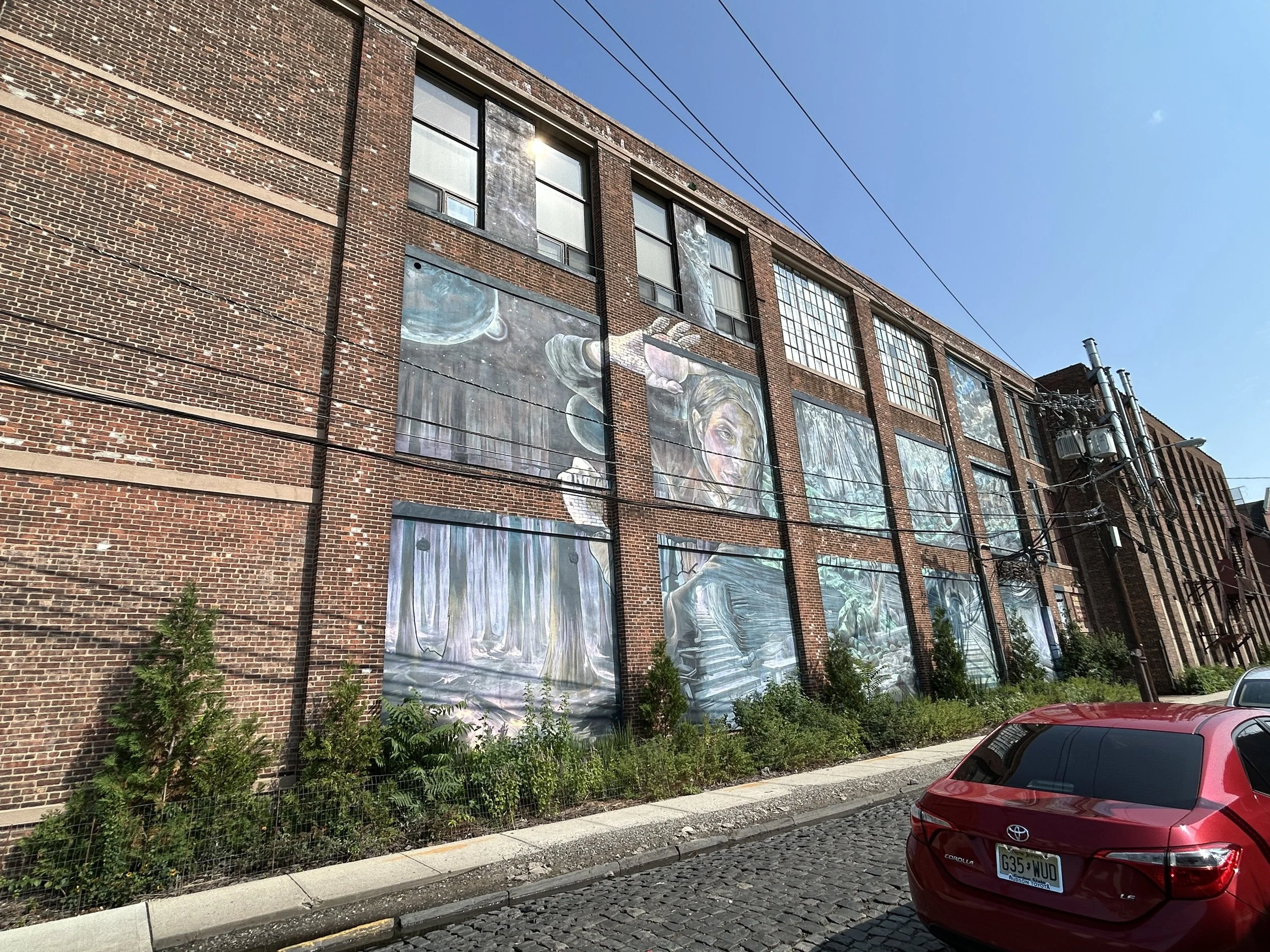
Distort’s Peach Wall Mural, off Communipaw Avenue.
The Peach War (1655) is the conflict that inspired the mural; a story that lives between documented history and legend. For the history and the legend side by side: David J. Goodwin - author of Left Bank of the Hudson — “The Peach Tree War” (davidjgoodwin.com). For the documented record: “Peach War Begins in Van Dyck Orchard” at Mapping Early New York. For the Munsee Lunaape perspective: “Munsee & Colonists at War” at Philipse Manor Hall.
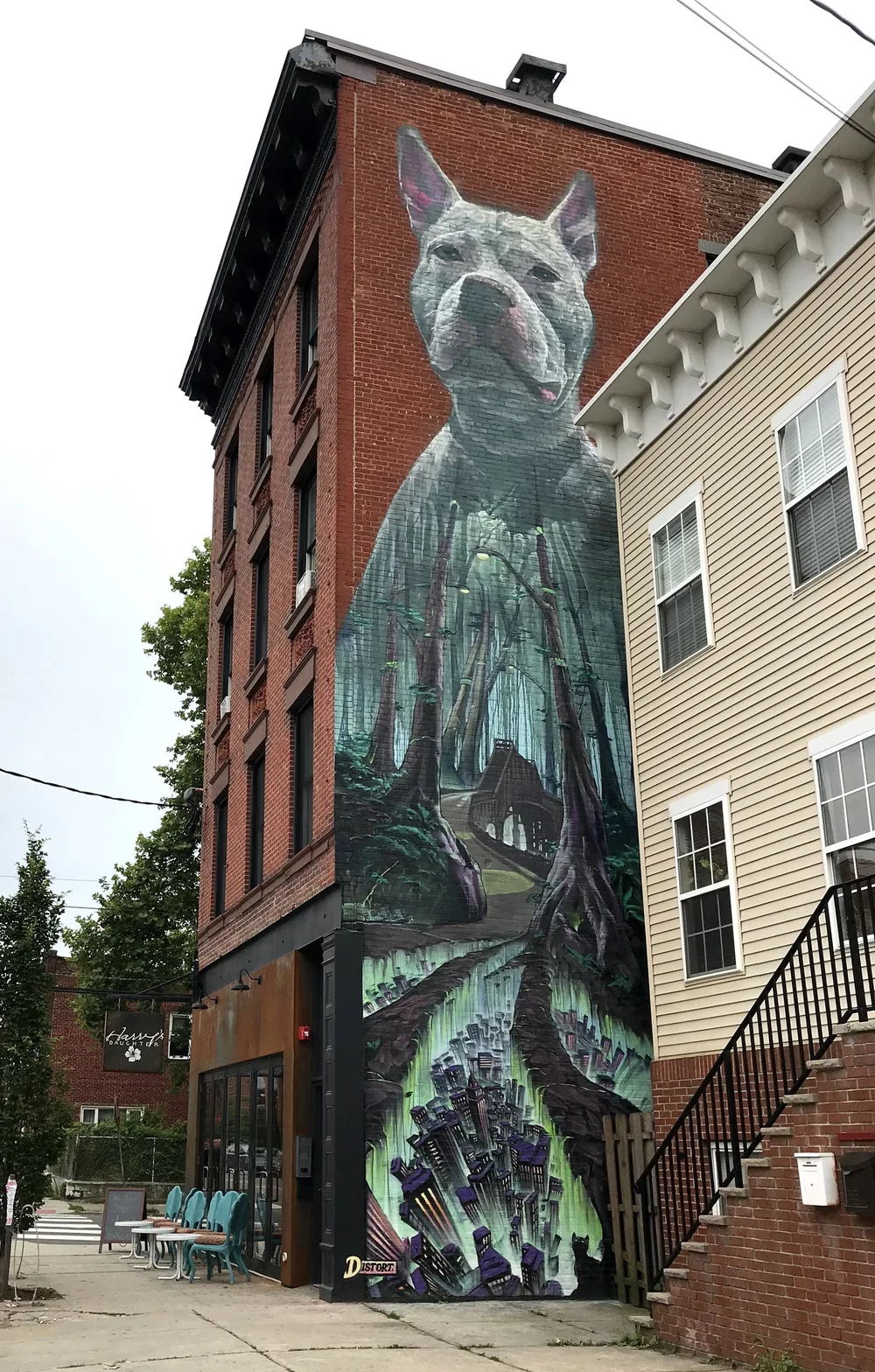
Radar by Distort - Distort painted his dog after he passed away. “It doesn’t bring him back, but I loved looking at him.”
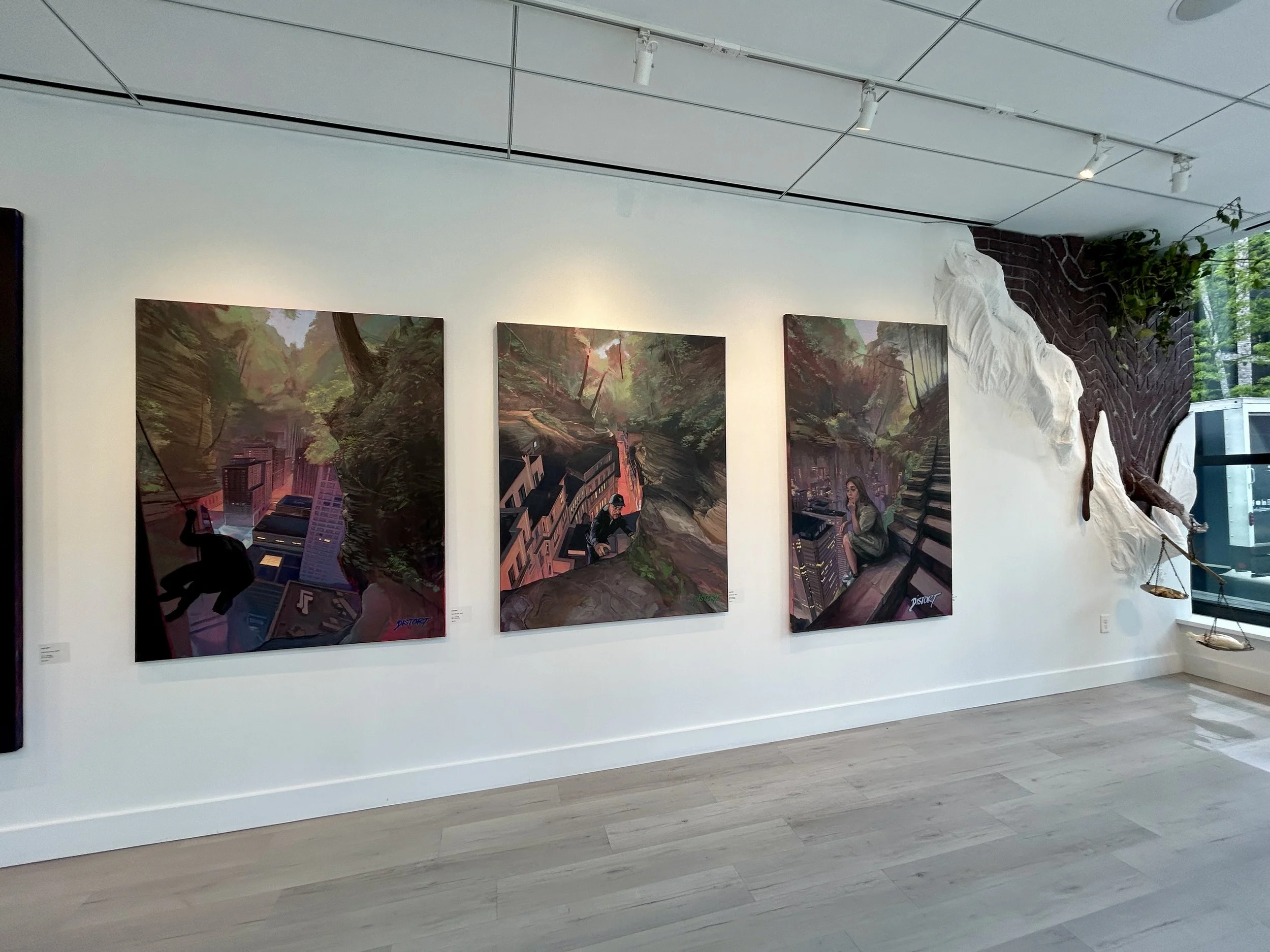
Distort - Ending Up- Solo Show at Arthouse in 2025
Resources
Jersey City Mural Arts Program — where DISTORT painted his first large-scale mural and went “from hiding to participant.”
Deep Space Gallery — home of “Reaching for the Steal” (2020). Jenna Geiger and Keith “Dutch” VanPelt are my guests on Episode 329.
Art House Productions — home of “Ending Up” (2025), curated by Andrea McKenna (a past guest on this show).
Emilio Florentine (Corey) — the muralist who ushered DISTORT into the mural program.
Alphaeus Philemon Cole (1876–1988) — DISTORT’s signature-question pick: born in Jersey City, son of wood-engraver Timothy Cole, taught portrait and still-life painting at Cooper Union, lived his last 35 years at the Chelsea Hotel, painted until age 103, and died at 112 as the world’s oldest verified living man. Magical sinkhole unconfirmed.
John Bachmann — the 19th-century bird’s-eye-view lithographer DISTORT mentions — the same artist Kati Vilim and I marveled at in Episode 328. My essay on him is on the Substack.
Kota Onouchi at IMUR Gallery — the Jersey City painter devoted to old-master techniques who gets a shout-out in this episode. IMUR is Ivy Huang’s gallery — hear her in Episode 327.
Music: Our theme music is “How You Amaze Me,” composed by Jim Kalbach and performed by Jim Kalbach, Bryan Beninghove, Charlie Siegler, and Pat Van Dyke.
Support the Show: Subscribe to the podcast and sign up for Nat’s Substack to receive additional stories and visuals that complement each conversation.
Share Your Story: What sidewalk stories have you discovered in your neighborhood? Share them with Nat through email or social media.
Full Transcript
Distort: [00:00:00] I saw the whole block as if it was on time lapse and fast-forward. From the building being active and this older guy and his story of it, to us painting there, to it being torn down, to me painting a mural across the street. And it all seemed like time condensed into a brief moment. And there was no experience that one person could have of the entirety of that location. But you kind of become aware of the layers a place has, and that the connecting thread is really human beings,
Nat:
A few years after I moved to Jersey City, I walked down Communipaw Ave, and in a side [00:01:00] street I saw this big mural on a building, a woman holding a peach. I was already obsessed with murals and graffiti, but this one made me go home and dig. What was it about? And why was it called Peach War? What I found was a story from 1655, that nobody had ever told me about, and it changed how I would look at this city ever since. It honestly is part of why this podcast exists. The artist behind that mural signs his work Distort. You've seen his walls if you live in this area, even if you don't know his name. He painted one of the largest murals in New Jersey ever by a single artist right outside the Holland Tunnel. He's painted in Miami, Istanbul, Los Angeles, Philadelphia, and here. He keeps his face out of photos and his name out of headlines, but today you'll hear him which feels right for an artist whose whole work [00:02:00] is about making you look closer. This is a bonus episode. This spot in the season was supposed to be my solo show as always, but once this conversation happened, there was no way I was going to sit on it. We will talk about shields made from car hoods, why a graffiti artist studies the old masters, and what it means to paint the face of someone a neighborhood is grieving. And we will talk about a first-ever sculpture he calls a monster. I'm Nat Kalbach, and this is Sidewalk Stories
Nat: Hey, I'm so excited to have, David here, Distoart or Distort. What is the right way to say it?
Distort: Distort is how I, sign all my work.
Nat: That's your tag
Distort: Art is my, yeah, Distoart is the company name.
Nat: Gotcha
Distort: Yeah, and you can call me David. Yeah
Nat: You have been painting in this city for quite a long time. How long [00:03:00] are you in Jersey City?
Distort: I think 16 or 17 years I've been living here, but I was painting in Jersey City before I lived here for a while too
Nat: You're from Philly, originally, is that
right?
Distort: no, I'm from New Jersey. I went to school in Philly. I was there for probably about five or six years in Philly.
Nat: So when you paint a wall in Jersey City, is that different for you? Does Jersey City ask you, something that other cities maybe don't?
Distort: Each project is different. I've had walls where they really lend themselves to a historical approach, and I've had walls that have more of a community approach in terms of it being about the present. The walls I've done with the mural program have given me a lot of creative freedom to choose my direction.[00:04:00]
So I usually go with a historical approach. But then sometimes it's for a business and you cater to the business, or sometimes it's just for fun.
Then I just sort of do it how I feel in the moment. Or sometimes it's a collaboration with me and my friends, and then we have a conversation about what colors we're gonna use and what else we're gonna paint
Nat: I wanna ask you about the Peach War, let me tell you a little bit about that before I go deeper into asking you. I moved to Jersey City in 2013
I always loved, graffiti and murals in Europe and wherever I was traveling. And then one day, I think, 2016, 2017, I saw your Peach War, mural, and it really blew my mind.
Because even though I was obsessed with murals and graffiti, I wasn't really thinking about the hidden history [00:05:00] of the city. And when I saw the depiction of the woman that is holding the peach, and then was looking into the title, I was like, wait a minute, what is David talking about?
It really touched me very deeply, and it was the first time that a mural made me look into history. I really have to thank you for that, because it was like, oh, shit, there's something happened here that no one's talking about, so what drew you to depict that story, and then in that way how you did it?
Distort: Sure. That's that's great to hear. That mural was a first for me as well because that was both my first mural with the Jersey City Mural Program, and it was my first time being given a lift. I had never driven a lift before. And it was really my first large scale [00:06:00] mural. So there was a lot of learning curve on that one.
I did some research. I came up with a design, and when I started painting, I realized that- The sketch I had was very small. I'd only been looking at it on the computer screen. And wow, that wall was really big. I'd never really experienced that before, kind of the difference of scaling something up.
And I didn't use any projector or grid or anything. I just freehanded it. There were parts that went really well that were easy, and then there were parts that I really struggled with. The portrait was really difficult for me. I repainted it a bunch of times. There's still sometimes photos that pop up where [00:07:00] it's unfinished, and I really don't like how it looks in those photos.
I still have a lot of self-critique about that particular mural, and I see it every day 'cause I work there. It was, definitely a first for me. It really began my fascination with translating, the location of a mural into an image. And the Morris Canal ran in back of that building. The last stop on the Underground Railroad was at the end of the Morris Canal.
There was so much I learned. I remember seeing maps of where Liberty State Park is now, and it was all railroad docks. And, learning about Communipaw Avenue being a trail before settlers even arrived, and it's sometimes referred to as the first road in what became the United [00:08:00] States of America.
So it was a really important mural for me. I Kind of go back and forth about repainting it sometimes. Been talking to the city, it's really faded, so I wanna revamp it. But yeah, it's definitely kind of a landmark in my career, in my journey of becoming a mural painter. I think another interesting part of the story behind that mural for me personally was I was still pretty active at that time doing graffiti, and I was really reluctant to meet, Brooke Hansen, who ran the program, and do anything to give up my anonymity and put myself at the feet [00:09:00] of people I felt like I should be hiding from.
And it was, Corey Fleming, who goes by, Emilio Florentine, another great muralist who was, involved in the program that really ushered me in and made me feel comfortable and safe. I think that was, a really important leap for me to go from being in hiding to being a participant.
And I kind of feel like the approach that I took, a civic approach, made me feel like I was doing right by, by everybody for that.
Nat: A quick note from me. The Peach War of 1655, that is one of those stories that lives somewhere between documented history and legend. There was real violence between Dutch settlers and the Lenape, and like a lot of what happened here before [00:10:00] anyone kept careful records, the details depend on who's telling it.
I'll put what we know and what we don't in the show notes. What I can tell you for sure, a wall on Communipaw Avenue made me go looking. That's what murals can do
Yeah, that is so interesting I was a paralegal, and a big part was actually, helping graffiti artists that were, caught by, the police and had to go to court.
We usually got everyone out and I think that's where my interest and love for all this came, about.
I would look at, photos of, tags and, all the stories, and and they were so freaking cool, so I, I get that switch from, Or not, I mean, you're still both,
Distort: There's still both, yeah. And it's reminding me too that when I was on the lift, there was a DPW worker that was operating the lift for [00:11:00] me for the beginning of the project, and he told a story about the empty lot that was across the street and how it used to be a building, which I, I remember We used to paint in that building.
It was kind of burnt down and abandoned, and he told a story of how it burnt down
and that he was blamed for it and had to change schools. And- I saw the whole block as if it was on time lapse and fast-forward. From the building being active and this older guy and his story of it, to us painting there, to it being torn down, to me painting a mural across the street. And it all seemed like time condensed into a brief moment. And there was no experience that one person could have of the entirety of that location. But you kind of become aware of the layers a place has, and that the connecting thread is really [00:12:00] human beings,
Nat: You also create where you use materials that you call shields. Can you tell us a little bit about the shields, for those who have not seen them?
But also it seems there's a narrative running through those shields. Are you imagining a specific kind of person who would need the shield, is that person you? Who is that person, what are these people up against if they need a shield? That's a lot of questions in one, sorry.
Distort: No, it's a great question. I have, definitely a theme in my studio work that makes it into my public art but is a lot, it's a lot more pronounced in my studio work. The shields are, car hoods. They're made from car hoods. They're, they pretty much are car hoods, and then I engrave and paint on them.
And they [00:13:00] are the siblings to what I call scrolls, and the scrolls are made from spray cans or fire extinguishers. And they have a medieval look to it when they're all hung on the wall together, and they tell a, a story of our society. And for me, it's an homage to the tradition of art that I was educated in, which is the European tradition, academic painting, and the European Renaissance, which came out from the Middle Ages.
It's also my own personal history of my creative mind and, uh, engagement in fantasy, which really started as a kid reading, like, King Arthur, and I think a lot of [00:14:00] kids are really obsessed with knights and dragons, and I, I really loved the arms and armor at the Met. Before I even knew I liked art, I would get dragged to the museum and run straight to the arms and armor and look at the, engraved armor and ornamental shields and swords and axes.
And, little boys have, like, a infatuation with warfare and violence and, monsters. So I found myself in my teenage years going to protests, after the Iraq war started, Afghanistan war, and found a similar fascination in the m- the more aggressive protesters. They were [00:15:00] called Black Bloc.
They would kind of use anything to go up against the police, and the police would be on horseback, and they had, little, barricades that they would set up and- I just really liked their energy and it, it mimicked to me some of the same themes of justice and, uh, kind of connected these things from across my life.
So when I started finding car parts on the street, I think it started with a wheel well of a truck, and I picked it up on my bike, and I felt like I had a shield that was in between a Renaissance shield and a, and a protest shield. And I wanted to decorate it like it was Renaissance style or like a Middle Ages shield that you could bring to a protest.[00:16:00]
And that really started this whole vocabulary for me of taking found objects, usually auto parts that were discarded or spray cans or fire extinguishers, which are graffiti tools, and turning them into objects that mimic, what we would consider high art or, art from the academic European tradition.
So I try to recontextualize what would Renaissance art look like if it was for today. I had the chance to visit the Vatican and it was a very intense experience for me because I saw in person some of the art that is To me, the best art that's ever been made, the Pieta, Bernini's Ecstasy of Saint Teresa.
I'm a huge sculpture fan. And [00:17:00] even on the building, are statues. You couldn't count all of them. There's so much opulence there that I couldn't help but feel like this is the wealth of the world siphoned and appropriated towards this one institution of the church, which was one with the government.
So going back to the times that we're in, and especially the times when I kind of developed this vocabulary, it was-- I felt like it was a similar thing happening where I was in America, which has wealth siphoned from all over the world. And maybe coincidentally, maybe not, we're engaged in war in the same part of the world where the Crusades had happened, which was happening during the time of the Middle Ages leading up to the Renaissance.
And those [00:18:00] parallels, reinforced this narrative. If you look at each one of them, they all depict different things. A lot of them are beheadings like David and Goliath, which to me is-- it's sort of an anarchist symbol of the little guy chopping the big guy's head off.
A lot of them are Judith and Holofernes, which was, a woman and her handmaiden cutting the head off of a king. If you don't know the story, just the image of two women chopping off a man's head has a certain, narrative to that. It's all triangulated. Phil-philosophy, history, politics, and art, and, the history of art.
I'm kind of looking to exist within that space of all those things.
Nat: For me, cars are such an American thing too. Everything is so car-centric, and the cars are getting bigger and bigger. It's [00:19:00] like part of that whole capitalistic, I don't know, arm- armor, right?
Distort: It is, yeah. And I learned later that maybe my need for armor is on a psychological level. It might go past what I like to talk about when people ask me and into, things where, you know, maybe art has been a protector for me in my life. And going back to my childhood, I really have felt like art has kept me safe.
I think there is an element of that too. And an element of the car being definitely a symbol of America and of the times that we're in for sure
Nat: You talked about being inspired by people like Bernini and Michelangelo and Caravaggio, and that you wanted to understand these techniques that haven't really been replicated, right? For some people it might be strange because they don't know your background as a fine artist, that a street artist or a muralist [00:20:00] would, chase that.
What is it about that lineage that you're returning to?
Distort: The same thing that makes me wanna look back at the history when I get a mural site, tracing things back to their root feels like a good way to have what I would call a, a cumulative approach to things. When I went to school in Philly, I, I went to a very acade- a ver- they call it academic, but it doesn't mean like, you know, academics.
It's cast drawings, still lives. It's art academic. The foundational, elements of art. That's what I was really trained in. But I was also the oldest graffiti city. So at the same time, I was immersed in the history of graffiti just by where I was. Seeing some of, [00:21:00] America's earliest examples of each kind of graffiti that exists.
Tags are just like the line movement, the kinda like the basic graffiti, but they really value that there. It's both the school and the city were foundational. The school at art and the city at graffiti, where you have to learn fundamentals. And I think the other reason why I'm drawn to that approach of Go look backwards and build out from that is because for much of my childhood and young adulthood Art was something I, I really enjoyed doing, but when I went to see art in modern art museums or galleries, contemporary galleries, I felt extremely alienated by what I was seeing 'cause I didn't understand it, and I still don't [00:22:00] understand modern art.
It made me feel unintelligent or unsophisticated. And when I talked to people that were my age, my peers, people that had great artistic talent that came from the world of graffiti, they similarly had no ability to relate to art. Eventually, it becomes, you just have to do something that's never been done before. Now, what that produces is
A lot of things that hadn't been done because they don't communicate. They're not successful in the same ways that some of the more crowdsourced, I like to say, traditions are. And so for me, it's about finding common ground. It's about having art be a tool of communication, If I wanna [00:23:00] paint a mural somewhere and I ask eight neighbors what was their day like today, what do they do, I'm gonna get eight different answers.
But if we start asking, "Hey, who was here before? What do you remember about the past of this place?" Then things converge. All these different perspectives start to go back and hit, hit a vanishing point where there-- it's just one thing or maybe there's different versions of it, but there's a lot more commonality.
So my attraction to older stuff, , it has to do with, um, a certain degree of commonality and a little bit of a rebelliousness against this, arbitrary art that didn't really relate. And, you know, here's just an example is, "Oh, my kid could do that," or, "I don't get it," you know?
These are things that really hit the public and their lack of [00:24:00] appreciation for art that I feel like those things are starting to become less popular in terms of what artists are producing now.
There's a return to craftsmanship, and part of that is a return to wanting to build on what came before instead of just do something that's never been done before.
Nat: Because at some point that's also redundant. Doing what no have, no one has done before has been done. I'm not a trained artist, and so, um, for me that is sometimes, it feels a little pretentious.
I definitely have more problems with contemporary art where I'm like, "I just don't get it. Is that the point?" I just don't feel it.
, That's a side note, but do you know Kota? He's a Japanese artist here in Jersey City. He just had a show at, IMUR, I-M-U-R downtown, he's amazing. He's totally into, the old, Western masters, really trying to [00:25:00] do etching in tiny and big and, doing oil paints and I talked with him about, why, and he was like, " I can't believe that no one is interested in, the Western world." He's, really into, getting the feel and trying to get to the techniques, and it's so interesting. So I think you two have some commonalities and would probably, have a great conversation
Distort: Yeah, I would love to meet him
Nat: You sometimes, you take on a portrait. A memorial of someone who passed away, who was loved by people.
And you know that people will pass this mural, , all the time. Does that change how you approach thing? I would be like, "Whoa, this is a lot of pressure to depict someone, that they lost .
How do you go about it? Do you only depict people that you knew too, or do you, listen to stories about the people Or do you go by a photo and try to be as close as possible?
Distort: Yeah, I'll ask [00:26:00] for a few different photos and see which one works or look at a couple different ones. It is really difficult. It's a lot of pressure, but I have a policy of if somebody asks me, then I just do it. I don't charge anybody money for that. I usually don't sign them. Even if I didn't know the person, it can be difficult.
The responses that I've gotten in terms of seeing people find a catharsis in it is unlike anything that I've experienced. Art doesn't seem to have a utilitarian function. So we don't need it. I know that people might disagree with that, but really in terms of like necessity for survival, it's not [00:27:00] really one of them.
But I don't know if there's many other things that can provide relief for somebody grieving as much as seeing the likeness of somebody that they miss looking at. And the experience that I've had painting people and seeing their loved ones find some healing in that -- those are the highlights of my whole experience being an artist.
There's nothing that that could compare. There's no selling a painting. There's no, big commission or anything to my ego that would rival somebody thanking me and knowing that they have a place they can remember somebody. I'm very visual. I painted a, a mural of my dog after he passed away. And I mean, it doesn't bring him back, [00:28:00] but I loved looking at him. When you love somebody, part of it is their, their visage, their image that you miss. So I think there's something to be said for just being able to look at a person that's not there anymore and see them.
I take a lot of pride in that. I definitely feel like I get to know them while I'm painting them, whether I knew them or not. And I always think I'm fucking it up every time. And then I, I turn around to apologize, and they're like, "That's, that's it. You got it." And I say, "All right.
I'll, I'll take your word for it. You knew him, Or her." There's a lot of self-doubt, but I think, I manage to get through it
Nat: That's beautiful. . You really have to see that person in a deep, on a deeper level than just on a surface level. And seems like that it really shows to the people that know the person, so that's amazing. Can I ask you about, you talked about it in a different [00:29:00] interview, you were working on a insane first outdoor sculpture and, you called it a monster.
Like, it's, it's massive.
Distort: It's big
Nat: can you talk about it? Is it almost done? What is it?
Distort: Yeah, I'm done with my part, but it's not in the world yet because it's getting cast. So it'll go to a foundry and get cast out of aluminum and then painted and delivered. And I am I would say I'm proud of it.
I don't know. We'll see when you work on something that long, it becomes part of you.
Nat: Is that weird to give it to someone else, the foundry, and they are building it even though you told them how ?
Distort: This whole project was weird. It was really a blessing. But there were so many things that were completely outside of my normal art practice. It went, it just went way outside of anything I've ever been used to. The scale of it, the timeframe of it, the amount of Other [00:30:00] people that helped to make it happen.
I had creative freedom, which is the biggest, gift that you can be given, but there's engineers and, uh, construction managers and I mean, I would laugh sometimes to myself because I'd be on a Zoom call with two engineer firms and a, team of, uh, art advisor managers and things that I just couldn't fathom it because other than an assistant, , it's just me.
It's just, like, me and my buddy building this thing. But I'm very grateful. I'm, like, super, NDA'd about some of the details of it, but what I'm really grateful for about that project is, as an artist you have to do a lot of, commissions to get by.
It's not all, "This is what I felt like [00:31:00] painting, so I painted this." I had gone through about a decade of balancing my own work with projects that paid the bills, and I would say most of them are things that never go on my website, never get posted on Instagram. I don't sign a lot of them. It's not my work. And you learn from all those projects. Each time you do something you wouldn't have done, you probably learn more than when you do something that you were gonna do anyway.
Pushes you outside your comfort zone. But eventually, you're less in touch with what's at the core. And this project really is the core for me, and it recentered me, and it gave me enough financial stability to not keep doing as much commercial work as I had done. So it allowed me to refocus myself and recenter myself.
At the same [00:32:00] time- it's really hard to not have a thing that you do , in terms of when people go to your website or your Instagram the best way to brand yourself is to make it easy to understand. I'm the guy that does this, and I keep on doubling down. And there's a lot of confusion about the graffiti work with the mural work.
The studio work, I think, escapes almost everybody there's people that know me from graffiti, and then out of those people, a fraction know about my murals. Out of the people that know about my murals, a smaller fraction knows about my studio work. And now I have a sculpture. This is even more off of the trail.
I'm grateful for Getting the chance to kind of unravel [00:33:00] this, uh, I don't wanna call it gimmicky, but, this world where an artist does one thing. And this also goes back to the Renaissance where people really took pride in the diversity of their own practice. My takeaway from it was I'm the most in my element when I'm uncomfortable and when I'm doing something that's a format that I have a lot of love for but I haven't tried it yet. So now I just wanna do a little bit of everything and surprise people. I'm being vague about the sculpture in a way because it's gonna be this great surprise.
I'm excited for that. And now I'm thinking about what would be-- what's gonna be the next surprise, and working on more surprises and, that's kinda keeping me energized
Nat: I love that. And, I'm nowhere near where you are, but, I've done, a lot of, , art workshops to pay bills, and I didn't do any of my own [00:34:00] work. And now everyone's like, "Oh, she's doing all Jersey City stuff."
And I'm like, "Don't put me in that box." Because I clawed myself out of that, teaching workshops thing, I'm like, "No, no, no, don't put me back in a box." But at the end of the day, all things for me are connected, and I think for you they are too. History and research and storytelling. There is a thread there, right?
It's just, maybe not visible for other people, but that's their problem as long as you know the thread, right?
Distort: Yeah. I mean, it's my problem too. I want people to get it. I'm aiming for that. I think that's the burden we have is you wanna build your own box. I don't wanna be in the boxes that other people made, but I do wanna fit into a container that I've made for myself.
So have that sort of consistency across all these different things I do where they all have the same energy, message, [00:35:00] kind of my person, character coming through all of it, and I want for people to be able to recognize those overlaps, as I'm sure you do.
It's a lot harder when you're asking people to connect things that they have as disparate, in their mind that they don't relate to each other, but that's what makes it a fun challenge.
You know, I had separated out this is a mural, this is graffiti. I started really making my graffiti more image-based, and I never wanted to put lettering into my murals, but I started putting more imagery into my graffiti and realized very quickly that I don't need to make my graffiti look like just everyone's graff- Like, I can just make my own rules.
If I love it and it's all consistent for me, I can wipe away these walls [00:36:00] and, You can really feel comfortable with a bunch of things, but then it's the areas between those things you could spend the rest of your life just sort of bridging gaps and paving roads between things that you love.
And I think that's one of the most fun parts of it all.
Because that's-- it's all the groundwork's been laid, and then you're just cutting across
Nat: For me it's, storytelling and talking with people and making connections between place, place and...
Like, I've moved so many times, the way how I learn about a place is through, studying the buildings and then finding out the stories behind them, I'm now cool with it that, that's the connecting part, and ever since I know it, it's actually making me way less, crazy because I used to be like, "Oh, my God," like, there's no consistency and fucking branding and all that shit. But anyway, it's not about me.
Distort: You're right, and it becomes repetitive, I think, too. [00:37:00] The way to keep evolving is to have different focuses that intertwine. And then , you never get stuck. When you're repeating the same process and it's a closed system, it's gonna end up feeling stagnant and get recycled.
When you open that system up, it might be harder to define it to other people, but it's like opening the windows in your house.
Nat: Exactly. You breathe
Distort: Yeah, you breathe. Yeah
Nat: You said that art has to look cool first and communicate something second. Symbolism, has to ride along and not lead. Is that still something you're, like, would say, like that?
Distort: I think those are the two important factors. I don't know if, I put one before the other. Maybe in terms of getting people's attention, you wanna have it look cool so people get intrigued. But I think they're both really important. To me, [00:38:00] that's my job description.
Make it look cool, make it mean something. If I don't do either one of them, I don't feel good about it. The art that I really like is people that have made one thing out of those two, where the meaning and the aesthetic are so enmeshed that you couldn't even separate them.
Sometimes when I'm watching a TV show or a movie, I'll notice that the characters and their development are, , enmeshed in the plot. It's not a plot that has characters in it. It's not characters that have a plot happening to them. Those two elements are one thing. That's really-- That's good storytelling when people are able to do that.
And s-substance the message and the medium, the way it looks and what it means should be [00:39:00] in-inseparable really. There's this platon-platonic i-idea of duality of the physical world and the world of the mind. Maybe those two things are that, you know? They're the idea and then the physical reality. If anything, I would probably put the idea first. No, I don't know. I don't I don't know if I could, uh, put one over the other.
Nat: If money and client expectations, if you can put that aside what is the dopest shit you'd want to make right now?
Distort: Um, I'm working on a graphic novel. I'm excited about that. The sculpture was a big thing that I got off my chest. I really had wanted to make that for a very long time so that I feel lighter. I'll feel even lighter when it actually exists in the world in metal. I'd love to do another show. My studio art hasn't really gotten the attention that I'd like to give it. So I'd like [00:40:00] to do a big show with all the lessons I've learned, all kind of correcting some of the mistakes I feel like I've made in previous shows, and building on some of the successes that I feel good about.
And I can see that in my mind. I'd really like to be able to just kind of hunker down and work on a big exhibit. I think that would be my next goal
Nat: I would love to see that because I love both of your shows that I've seen, Deep Space and Art House, and, I love that you also incorporated parts that are site-specific when you did some of the plaster work and the bricks coming through I would love to see you in a, huge, raw space somewhere.
That would be so cool
Distort: Yeah, I have it in my head. I just keep thinking about it and looking for the right opportunity for that. So I think that would be my next kind of big project that I'd like to share with everybody. And in the meantime, I [00:41:00] love painting murals, I love doing graffiti. I like, uh, kind of breaking up the year, breaking up the day.
Nat: My last question if you could meet anyone from Jersey City's past, who would it be, where would you meet them, and what would you ask?
Distort: Hmm. There was an artist that was born in Jersey City. I think his name was Alphaeus Cole. I don't know much about him, but he was an academic artist. I think he taught still life painting in New York. But he lived to be 112 years old Which is crazy. And I would like to ask him what he ate.
What his, what his diet was. And whether he wore gloves when he painted, what sinkhole in Jersey City did he sip from or something, you know? Is there, like, a magical pond [00:42:00] somewhere where the chromium is just right or ... I would like to find that out.
And, you know, my favorite place in Jersey City is the Arches. So I, I, I love it down there. Maybe, maybe he would hang out down there with me, there's a lot of artists from Jersey City that, are pretty amazing. .. There was another artist that did, um, bird's-eye view,
Nat: I just talked with, uh, my last guest about it, Kati Vilim. She mentioned him. I just edited that episode and, and she was like, "Did you hear about this lithographer,
Distort: Yeah, super cool. Yeah,
Nat: like, "What?"
Distort: Yeah, really cool, and I love that kind of perspective, so he's another one. We've had a lot of good artists
Nat: 112. Uh, I don't know if I would wanna be 112 in this world right now, but it's an interesting
Distort: know. Yeah, I think I wanna see the end of the movie. You just gotta try and s- [00:43:00] stay awake for it, you know?
Nat: You wanna see how, what we gonna do with the shields? That's it
Distort: That's right. That's it. Got it.
Nat: I'm like, "Oh, shit. We might need them."
Distort: We might need them. I got it. I got the, the armory
Nat: That's where I run first when it happens, running to your studio and get one of the shields.
Distort: I'll suit you up
Nat: I love it. That was so cool. Thank you so much, David.
Distort: My pleasure. Thank you, Nat. Appreciate it
Nat: Wow, what a conversation. Every question I asked David opened a door I didn't know was there. This is an artist who runs toward discomfort, who paints the faces of people a neighborhood is grieving and won't take a dollar for it, who picked up a wheel well off the street and saw in it a shield from the Renaissance you could carry to a protest, and someone who told me that the layers of a place are held [00:44:00] together by one thing, us.
David, thank you for your generosity, your thoughtfulness, and for that mural on Communipaw that started all of this for me. You can find Distort's art at distortart.com and on Instagram @distortart. I will, link everything up as always in the show notes. And just look up next time you're walking through Jersey City.
And if the world ends, well, you know where I'm running. I'm getting suited up. So, thank you for listening to Nat's Sidewalk Stories. Our theme music is "How You Amaze Me," composed by Jim Kalbach and performed by Jim Kalbach, Bryan Benninghove, Charlie Siegler, and Pat Van Dyke. Find everything at natkalbach.com.
[00:45:00]
